Crypto Investigation Case: How AMLBot Recovered $270K Stolen from a Ledger Using OSINT


One day the client’s balance was there, the next it wasn’t. No suspicious emails they could point to, no unusual activity they’d noticed, no clear moment where something had gone wrong. Just 270,000 USDT missing from a Ledger hardware wallet.
What happened next showcases how OSINT can change the course of a crypto investigation to the benefit of the victim.
Response Timeline
Day 0 – The theft was discovered when the client checked their balance and found it gone. How the attacker gained access to the wallet has not been confirmed. The most common vectors are seed phrase exposure through phishing, a fake Ledger software update, or physical access to the device, but none of these were established in this case.
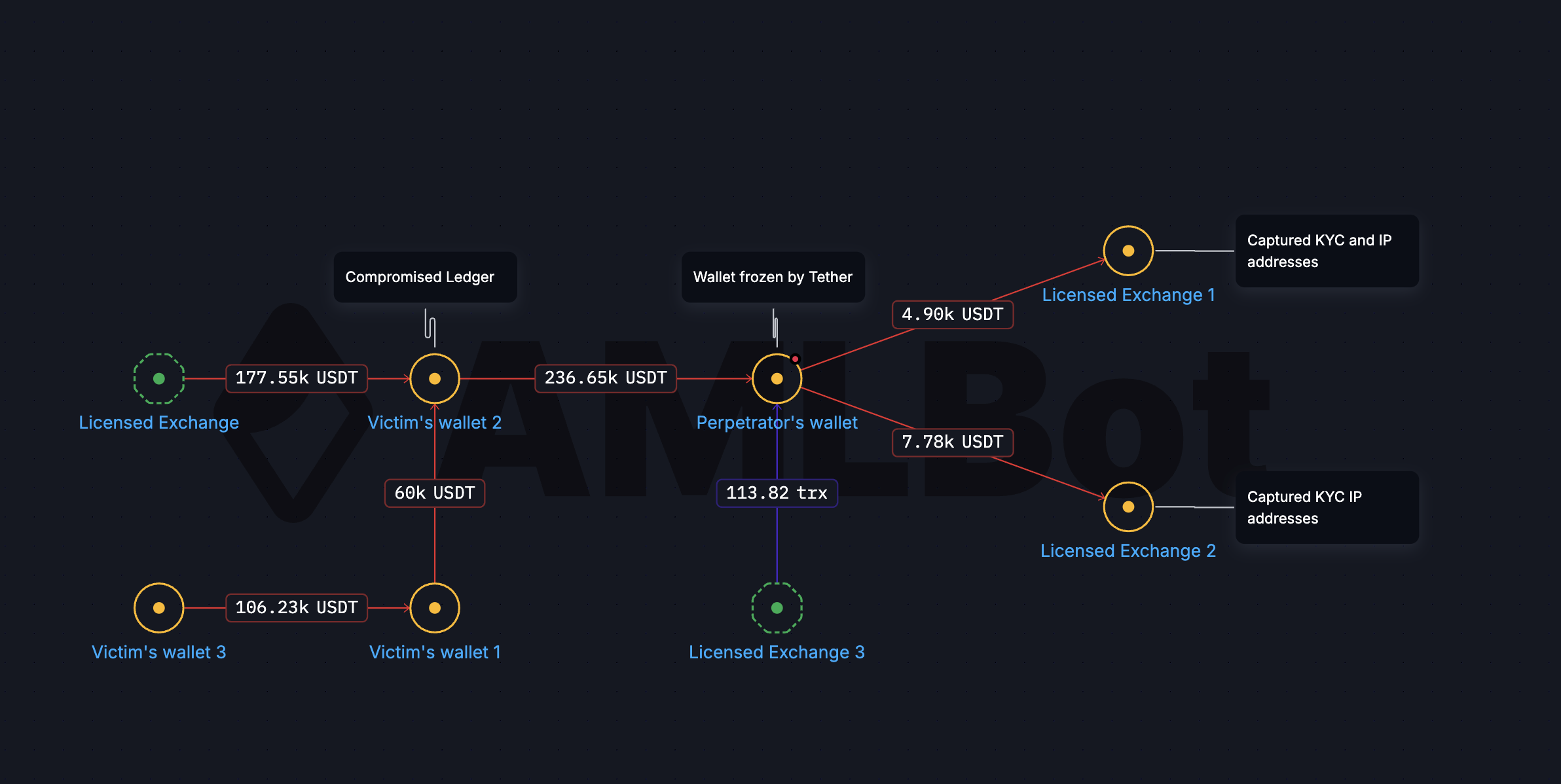
First days – Police Consultation and Documentation. AMLBot guided the client through filing a report with law enforcement and assembled the documentation package required to submit a formal freeze request to Tether – on-chain evidence, wallet attribution, a clear account of the theft and the fund movement. The request was submitted through the appropriate channels.
Tether confirms the freeze. Tether acted on the request. Almost the entire stolen amount – the large majority of the 270,000 USDT – was frozen on the attacker’s wallet. The recovery process is now underway through law enforcement.
The portion that moved further. A small portion of the funds moved beyond the frozen wallet before the freeze could cover everything. On-chain tracing followed it as far as it could go – but this is where the crypto trail became harder to act on alone.
When Tracing Isn’t Enough: How OSINT Picked Up the Trail
Blockchain tracing follows money. OSINT follows people.
When a portion of the funds moved beyond what a Tether freeze could reach, the question shifted from "where did the money go" to "who moved it." AMLBot’s team ran a full analysis of the attacker’s digital footprint – cross-referencing on-chain data with off-chain signals, behavioral patterns, and any identifiable traces left behind in the course of the attack.
The attacker made a mistake. In the process of executing or covering their tracks, they exposed a real IP address. That single data point, combined with the broader OSINT analysis, was enough to establish the attacker’s real identity and compile a complete dossier – documented evidence of who they are and their connection to the theft.
The dossier was handed to the client and to law enforcement. It now runs in parallel with the Tether recovery process: while the frozen funds work their way back through legal channels, investigators have a named suspect to pursue.
A Note on Ledger Security
Ledger hardware wallets are among the most widely used cold storage devices in crypto, and they are genuinely more secure than software wallets for most threat models. But "more secure" doesn’t mean immune.
The most common ways a Ledger can be compromised have nothing to do with breaking the hardware itself. Seed phrase phishing – fake websites or emails that trick users into entering their 24-word recovery phrase – accounts for a large proportion of Ledger-related thefts. Fake Ledger Live software updates are another documented vector. Physical access to an unlocked device is a third.
In this case, the entry point was never confirmed. What it illustrates is that hardware wallet security depends as much on how the seed phrase is stored and protected as on the device itself.
Had Crypto Stolen and Need Urgent Help?
You don't have to navigate this alone. Our investigations team handles on-chain tracing, OSINT, freeze requests, and law enforcement coordination. Get in touch and we'll start working your case right away.
-AMLBot Team

Follow/ Contact AMLBot:
🔗 Website
🔗 Support Team
🔗 LinkedIn
FAQ
What Is OSINT and How Is It Used in Crypto Theft Investigations?
OSINT – Open Source Intelligence – is the collection and analysis of information from publicly available or legally accessible sources. In crypto investigations it complements on-chain tracing by building a picture of the person behind the wallet addresses: IP addresses, account registrations, behavioral patterns, cross-platform activity. It becomes the primary tool when on-chain tracing reaches its limit. In the case above, an exposed IP address was enough to establish the attacker’s real identity and compile a full evidence dossier.
What Happens When Stolen Crypto Is Partially Frozen and Partially Gone?
Two tracks run in parallel. The frozen portion moves through the legal recovery process – law enforcement coordinates with Tether, and the funds are returned to the legitimate owner once the legal process is complete. The portion that moved beyond the freeze becomes an investigation target through different means: on-chain tracing, OSINT, and building an evidence package that law enforcement can use to pursue the attacker directly. Recovery and identification don’t have to be the same process – and progress on one doesn’t have to wait for the other.
How Much of Stolen Crypto Can Realistically Be Recovered?
It depends on three things: how quickly the investigation starts, whether the funds are still on traceable and freezable infrastructure when monitoring begins, and how much of the stolen amount has already moved beyond reach. In cases where the victim contacts AMLBot quickly and the attacker is still holding funds on-chain, full recovery is a realistic outcome. In cases where funds have already been partially moved or converted, partial recovery combined with attacker identification is often what’s achievable – which is still a significantly better position than no investigation at all.
What Evidence Does Law Enforcement Actually Need to Act on a Crypto Theft Case?
The most useful package includes: a documented on-chain trail from the victim’s wallet to attacker-controlled addresses, attribution of those addresses to specific services or entities, a timeline of fund movements, and – where available – off-chain evidence linking wallet activity to a real identity. AMLBot compiles this documentation as part of the investigation process. Law enforcement agencies vary in their crypto investigation capacity; having a complete, clearly presented evidence package significantly reduces the friction of getting them to act.
What Should I Do If Crypto Was Stolen from My Hardware Wallet?
If crypto was stolen from your hardware wallet, act fast. First, stop using the wallet and move any remaining funds to a new wallet created with a fresh seed phrase. Then, document everything: wallet addresses, transaction hashes, timestamps, screenshots, and any suspicious links, apps, or seed phrase exposure. Report the theft to the relevant exchange, wallet provider, and law enforcement, and contact a blockchain investigation or crypto recovery specialist to help trace the funds. Never trust anyone who “guarantees” recovery or asks for an upfront payment in exchange for returning stolen crypto.