Stablecoin Turnover in On-Chain Privacy Tools: AMLBot's Dune Dashboard
Intro
AMLBot has published a public Dune Analytics Dashboard tracking cumulative stablecoin transaction volumes processed through major on-chain privacy protocols. The dashboard provides real-time, interactive data on how stablecoins flow through crypto mixing and shielding services — segmented by protocol, asset type, and time period, with historical records starting from 2019.
The dashboard is freely accessible and updated regularly: Stablecoin Turnover in On-Chain Privacy Tools: AMLBot's Dune Dashboard.
Privacy Protocols remain one of the most consequential — and most misunderstood — segments of the on-chain ecosystem for AML Compliance. They serve legitimate privacy needs, from shielding trading strategies to protecting personal financial data. At the same time, they are routinely used in post-hack laundering, sanctions evasion, and fund obfuscation schemes. Despite this dual role, publicly available data on the actual scale and composition of stablecoin activity through these protocols has been limited. This dashboard was built to close that gap.
What the Dashboard Covers
It tracks the cumulative value of stablecoin transfers routed through privacy smart contracts across the following protocols:
- Tornado Cash — non-custodial mixer using fixed-denomination deposit pools, sanctioned by OFAC in August 2022. Despite sanctions and enforcement actions, the protocol's smart contracts continue to operate autonomously on-chain.
- Railgun — zk-SNARK-based privacy system that shields wallet addresses using Zero-Knowledge Proofs. Implements a Private Proofs of Innocence mechanism designed to screen against known illicit addresses.
- zkBOB — privacy protocol built around the BOB stablecoin, also supporting USDC and USDT transfers via Zero-Knowledge Proofs.
- Hinkal — privacy protocol supporting stablecoin and DeFi token shielding, including CRV (Curve DAO Token) alongside standard stablecoins.
Additional protocols are added as they gain meaningful on-chain volume. The dashboard does not claim to cover every existing privacy tool or blockchain, but it captures the most widely used protocols relevant to compliance and investigative workflows.
Tracked Stablecoins
The dashboard covers the following stablecoin assets:
- DAI — decentralized stablecoin issued by MakerDAO (now Sky). Tracked across Tornado Cash, Railgun, and Hinkal.
- cDAI — Compound-wrapped DAI, representing DAI deposited into the Compound lending protocol. Tracked in Tornado Cash, where it historically circulated through dedicated privacy pools.
- USDC — USD-pegged stablecoin issued by Circle. Tracked across all four protocols.
- cUSDC — Compound-wrapped USDC. Tracked in Tornado Cash.
- USDT — USD-pegged stablecoin issued by Tether. Tracked across all four protocols.
- BOB — stablecoin native to the zkBOB protocol ecosystem. Tracked in zkBOB.
- CRV — Curve DAO governance token. While not a stablecoin in the traditional sense, CRV is included because it is actively processed through Hinkal's privacy mechanism and represents a meaningful share of that protocol's activity.
Both canonical and wrapped token forms are included because they represent the same underlying economic exposure and are commonly used in privacy protocol interactions.
Networks
All data is sourced from on-chain transactions across Ethereum, BNB Chain, Polygon, and Arbitrum.
Who This Dashboard Is For
(a) AML Compliance Teams monitoring exposure to privacy protocols in transaction flows. The dashboard provides baseline data for calibrating risk models and understanding which stablecoins and protocols carry the most volume.
(b) Blockchain Investigators tracing funds through mixing and shielding services. Understanding which protocols process which stablecoins — and at what scale — helps prioritize investigative resources and contextualize on-chain findings.
(c) Risk Analysts and Compliance Officers at exchanges, OTC Desks, and payment providers who need to assess privacy protocol exposure as part of their KYT workflows.
(d) Researchers and Policymakers studying the scale of privacy protocol usage, the impact of sanctions enforcement on on-chain behavior, and the evolution of the crypto privacy ecosystem.
(e) Journalists and Analysts covering crypto compliance, DeFi privacy, and illicit finance trends who need verifiable, on-chain data rather than estimates or projections.
Why Stablecoin-Specific Data Matters
Most public discussions of privacy protocol usage focus on ETH volumes or aggregate totals. Stablecoin-specific data tells a different and arguably more operationally relevant story. In 2026, stablecoins are the primary medium for value transfer in crypto. When stolen funds, laundered proceeds, or sanctioned assets move through privacy protocols, they are increasingly denominated in stablecoins rather than volatile assets. Tracking stablecoin-specific flows provides a clearer picture of how these protocols are used in practice.
Freezing risk shapes user behavior. Centralized stablecoin issuers like Tether and Circle have the technical ability to freeze tokens at the smart contract level. How this capability affects stablecoin distribution across different privacy protocols is directly observable in the dashboard data.
In addition, different stablecoins indicate different risk profiles. A transaction flagged for privacy protocol interaction carries a different risk profile depending on whether it involves DAI, USDC, or USDT — and which protocol processed it. This dashboard provides the data needed to make those distinctions.
How to Use the Dashboard
The Stablecoin Turnover in On-Chain Privacy Tools: AMLBot's Dune Dashboard is structured with paired visualizations for each protocol and stablecoin combination:
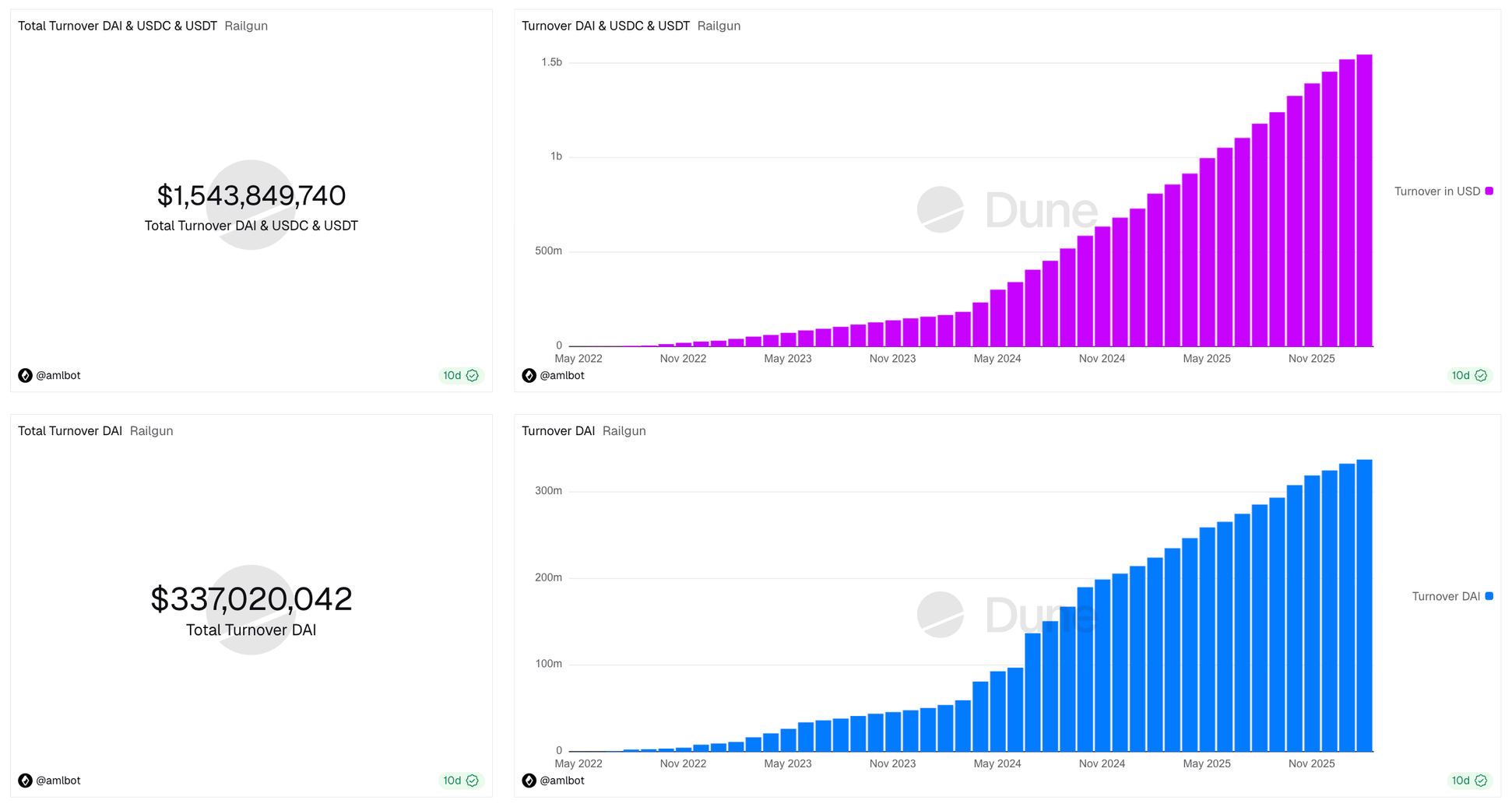
- Cumulative Total — a single figure showing the all-time USD value of stablecoin transfers through a given protocol for a specific asset.
- Historical Turnover Chart — a time-series bar chart showing how volumes evolved month by month, revealing trends, seasonal patterns, and the impact of external events (such as the OFAC sanctions on Tornado Cash).
Users can filter, compare, and cross-reference data across protocols to identify shifts in privacy protocol usage over time. The dashboard is publicly accessible and requires no account or subscription to view.
Methodology
- Data Source: On-chain transaction data indexed via Dune Analytics SQL queries against decoded smart contract event logs.
- Measurement: Each data point represents the cumulative USD value of stablecoin transfers processed through the respective protocol's privacy smart contracts. This includes both deposits into and withdrawals from privacy pools or shielding mechanisms.
- Updates: The dashboard refreshes automatically as new on-chain data becomes available. Historical data is cumulative and grows over time.
- Scope Limitations: The dashboard captures the most widely used protocols, stablecoins, and networks but does not cover every existing privacy tool, blockchain, or token. New protocols and assets are added as they gain meaningful volume. Figures reflect cumulative historical totals and may differ from point-in-time snapshots depending on when the dashboard is viewed.
Related AMLBot Research
This dashboard is part of AMLBot's broader on-chain research program. Related reports and tools include:
- Stablecoin Freezes 2023–2025: USDT vs USDC Data Analysis — analysis of how Tether and Circle use freezing mechanisms, covering 7,268 blacklisted USDT addresses and $3.29B in frozen assets versus 372 USDC addresses and $109M frozen.
- Comprehensive Analysis of Stablecoin Transfers, Compliance, and Ecosystem Dynamics — a broader study of stablecoin usage patterns, holder behavior, and Travel Rule enforcement challenges.
- Crypto Crime Report 2025–2026 — insights from 2,500+ real post-incident investigations, including how stolen funds are laundered through privacy protocols and other obfuscation methods.
FAQ
What is AMLBot's Stablecoin Turnover Dashboard?
It is a public Dune Analytics dashboard built by AMLBot that tracks cumulative stablecoin transaction volumes processed through major on-chain privacy protocols, including Tornado Cash, Railgun, zkBOB, and Hinkal. The dashboard covers DAI, cDAI, USDC, cUSDC, USDT, BOB, and CRV across Ethereum, BNB Chain, Polygon, and Arbitrum, with historical data starting from 2019.
Which Privacy Protocols does the Dashboard Cover?
The dashboard currently tracks Tornado Cash, Railgun, zkBOB, and Hinkal. New protocols are added as they gain meaningful on-chain volume.
Which Stablecoins are Tracked?
The dashboard currently tracks Tornado Cash, Railgun, zkBOB, and Hinkal. New protocols are added as they gain meaningful on-chain volume.
How often is the Data Updated?
The dashboard currently tracks Tornado Cash, Railgun, zkBOB, and Hinkal. New protocols are added as they gain meaningful on-chain volume.
Is the Dashboard Free to Access?
Yes. The dashboard is publicly accessible at dune.com/amlbot/stablecoin-turnover-in-privacy-tools and requires no account or subscription.
How can Compliance Teams use this Data?
It helps compliance teams calibrate transaction monitoring systems for privacy protocol exposure, assess which stablecoins carry the highest privacy-related risk, and understand the scale of mixing and shielding activity across different protocols and networks. It can also support regulatory reporting and risk model development.
Does AMLBot Provide Tools for Monitoring Privacy Protocol Exposure?
Yes. AMLBot's KYT Solution provides real-time transaction monitoring that detects exposure to privacy protocols. For post-incident investigation, AMLBot Tracer supports fund flow reconstruction through privacy protocol interactions.