AI Tracer (Beta): The First Self-Serve Crypto Investigation Tool Built for Everyone
Imagine. Your crypto was stolen ten minutes ago. You have a transaction hash. You know the funds are moving. But by the time you try to start figuring out where they're going, the thief has already crossed two bridges and split the funds across a dozen wallets.
Speed is crucial in crypto theft investigation. Every minute spent figuring out the tooling is a minute the trail gets colder. And while there are many professional tools and services to assist with investigations, they often require a solid analytical background to make sense of the outputs — or aren't accessible for tracing losses below a certain sum threshold.
AMLBot is building AI Tracer to address this growing asymmetry: criminals using sophisticated laundering schemes on one side; individual theft victims, independent journalists, and other members of the investigative community working with insufficient resources on the other.

AMLBot AI Tracer Overview
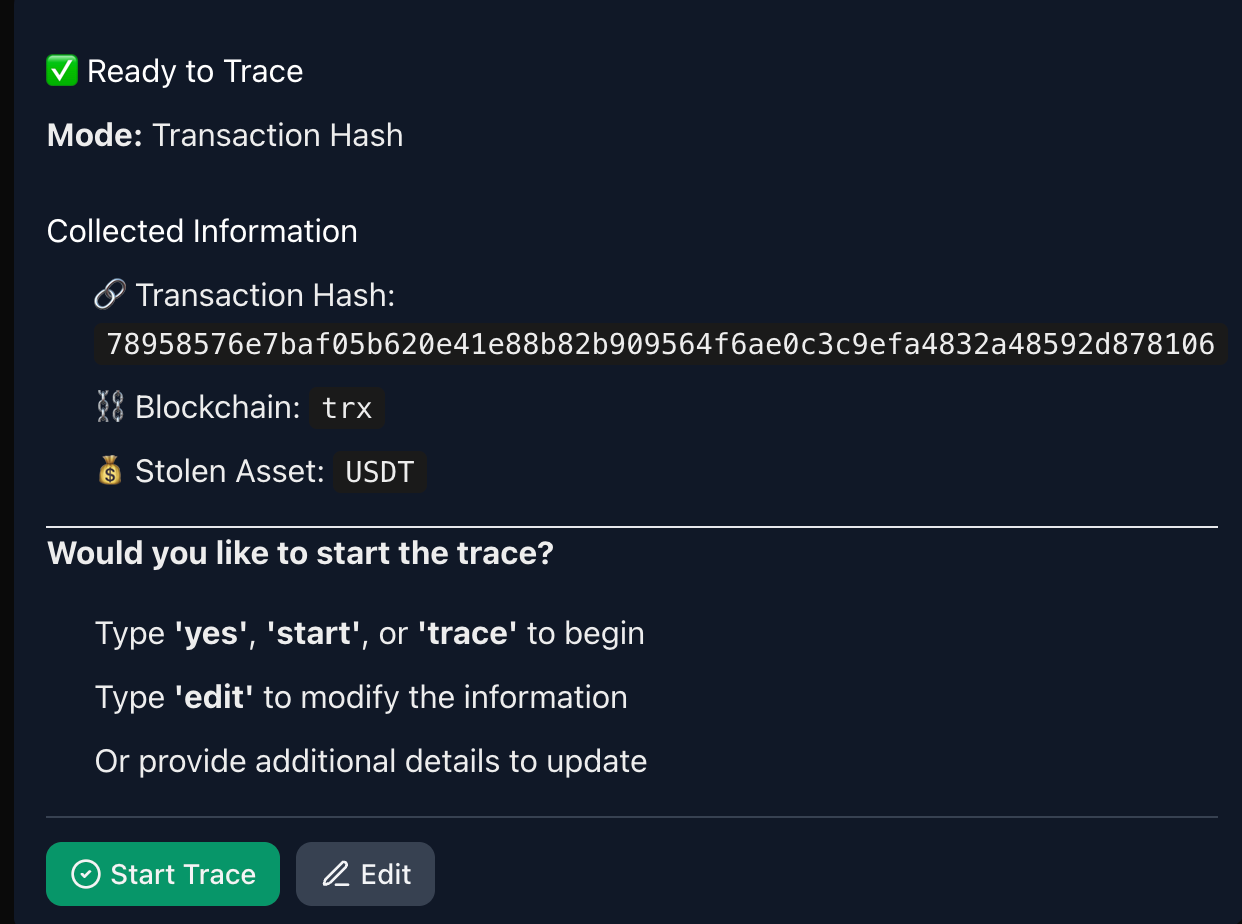
The workflow is straightforward. Enter the transaction hash associated with the theft, specify the blockchain (Tron, Ethereum, and others are supported) and the stolen asset. That's the full input. The system confirms the collected details and asks whether you want to start the trace.
Then the AI gets to work. Within minutes, it traverses the transaction graph, following the movement of funds from the victim’s address, through intermediate wallets, toward whatever endpoint the money reached. It traces the flow of funds through the wallets and matches known entity labels (exchanges, services, flagged addresses) against every wallet it encounters. And it builds a visual graph of the entire path.
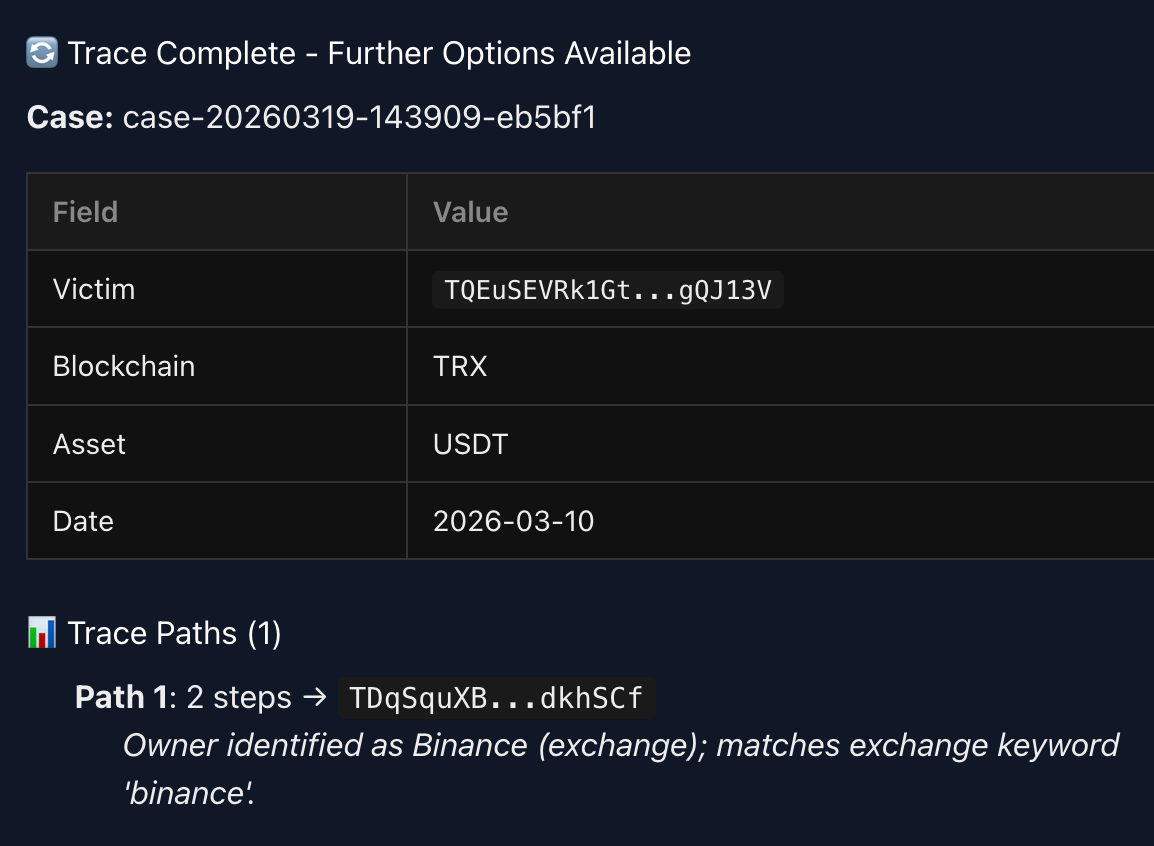
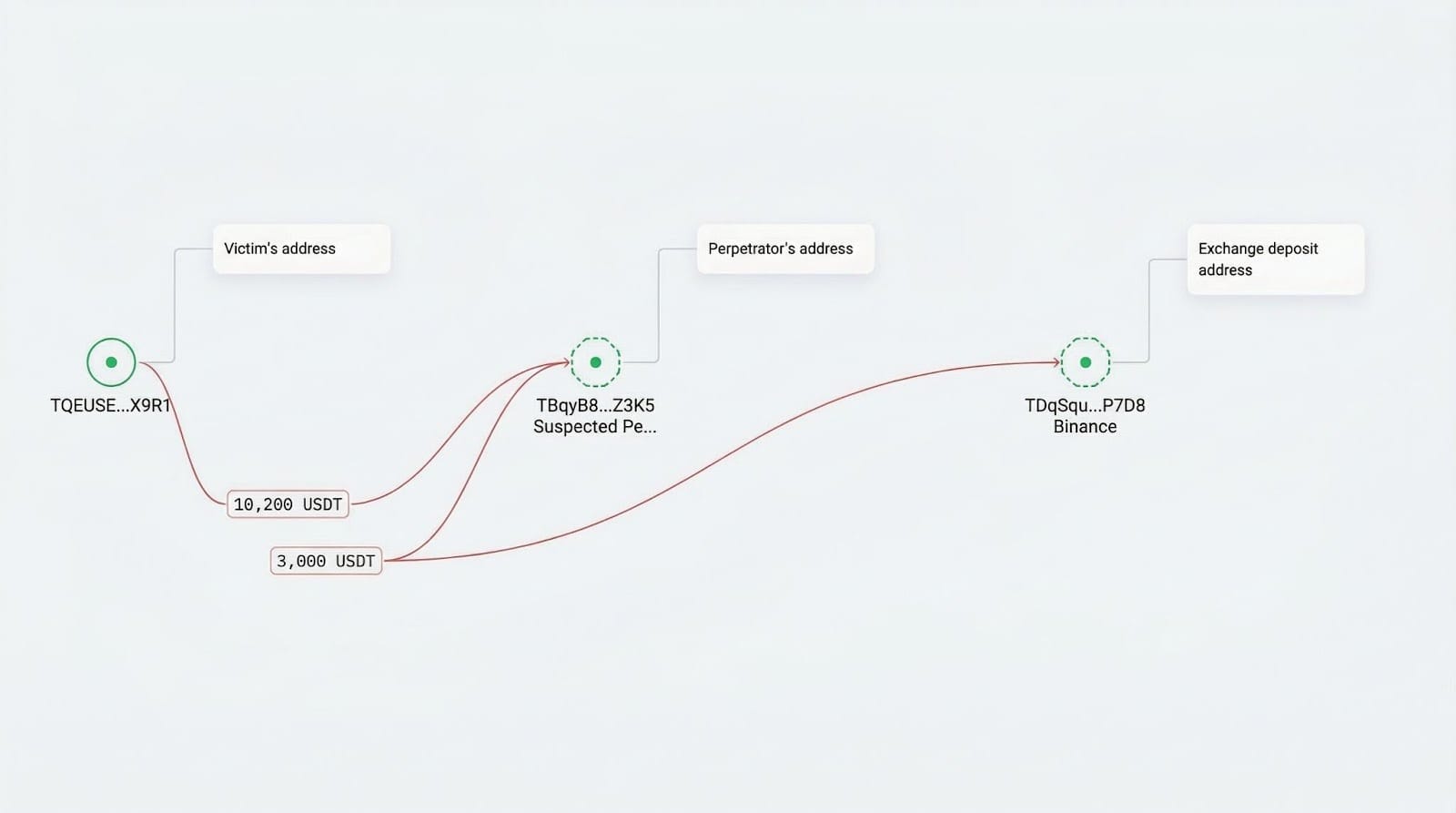
In the example trace shown above — a USDT theft on the Tron Network — the system identified a two-step path in seconds. Funds moved from the victim's address to a suspected perpetrator wallet, then directly to a Binance deposit address.
From Graph to Action: What to Do With Your Trace Result
The trace result is a starting point, not a conclusion — and understanding what comes next matters. If the AI identifies a clear fund path to an exchange deposit address, the documented trace becomes the foundation for the steps that actually lead to recovery. Exchanges do not freeze or return funds based on a victim's request alone. What moves a case forward is a police report backed by documented on-chain evidence — a labeled fund-flow map that law enforcement can use to formally request a hold or initiate KYC disclosure.
AI Tracer produces exactly that documentation: a clean, auditable visualization of the full fund path — from the victim's address through intermediate wallets to the identified endpoint — formatted for submission to both law enforcement and exchange compliance teams. For cases where the funds have moved further and the path is more complex — through multiple chains, mixers, or additional laundering layers — the trace serves as the starting file for escalation.
AMLBot's Crypto Recovery Service handles the full investigation process: exchange coordination, law enforcement liaison, KYC requests, and continuous monitoring until the funds are located or the trail is exhausted.
Who AMLBot AI Tracer Is Built For
The crypto investigation market has two speeds: enterprise-grade platforms built for agencies and institutions, and general blockchain explorers that show you raw transaction data without telling you what it means.
What neither category offers is an AI-driven, conversational interface that takes a theft transaction as input and automatically produces a documented fund-flow result — formatted for use by someone with limited blockchain expertise and no analytics background.
AMLBot AI Tracer is designed to fill that gap. It is built for:
- Crypto Theft Victims whose case is too small for professional blockchain analytics firms to take on;
- Law Enforcement Units investigating crypto crime at the regional or local level, who often lack the budget and training for enterprise tools;
- Independent Investigators and Investigation Agencies covering financial crime who need documented on-chain evidence quickly;
- Compliance teams at SMBs that can't justify major analytics contracts but still face customer theft reports and AML obligations.
Time Is Everything — For Everyone Involved
The window to act after a crypto theft is measured in hours, sometimes minutes. AMLBot AI Tracer is built to give you a documented fund-flow trace before that window closes — no deep expertise, no delay.
When stolen crypto moves, it moves fast. The fastest complete laundering cycle on record took under three minutes from theft to final deposit. On average, attackers gain a 20-hour head start before any public alert is issued. And fewer than 1 in 20 stolen-crypto cases ends in recovery.
The pressure is not only on victims. Law enforcement needs documented fund-flow evidence to open a case. Exchanges need traceable paths to act on a freeze request. Investigators need an auditable record before the trail disappears.
AMLBot AI Tracer is built to produce that documentation — automatically, in minutes — so everyone who needs to act can act before the window closes.
-AMLBot Team

Follow Us:
🔗 Website
🔗 Telegram
🔗 Support Team
🔗 LinkedIn
FAQ
What is an AMLBot AI Tracer?
AMLBot AI Tracer is an AI-powered crypto theft investigation tool that automatically traces where stolen funds went after a theft. You enter the transaction hash, confirm the blockchain and stolen asset, and the system builds a visual fund-flow map, showing every wallet the funds passed through and where they ended up. No deep blockchain expertise is required.
Is AMLBot AI Tracer Available Now?
AI Tracer is currently in final development and not yet publicly available. Free beta access is open to early applicants. Leave your details at [LINK] to secure a spot.
How do I Use the AMLBot AI Tracer?
Enter the transaction hash from the theft, confirm the blockchain (e.g., Tron) and the stolen asset (e.g., USDT). The system confirms the collected details and prompts you to start the trace. The AI then analyzes the transaction chain and returns a visual fund-flow graph, identifying the exchange or service where the funds arrived — where that information is available on-chain.
What does the Trace Result Look Like (AMLBot AI Tracer)?
The result is a labeled visual graph showing the victim's address, any intermediate wallets, and the final destination. For example, a deposit address at a named exchange like Binance or Kraken. It also shows amounts transferred at each step and flags known entities at the endpoint. The output is readable without technical knowledge and can be used as supporting evidence in a police report.
Can AMLBot AI Tracer Help me Get my Crypto Back?
AI Tracer produces the documented evidence needed to take the next steps. It does not directly recover funds. If the trace identifies that stolen funds reached a KYC-compliant exchange, you can submit the fund-flow graph to that exchange's compliance team and to law enforcement, requesting a freeze. You can also file a police report using the trace as initial evidence.
If you need hands-on recovery assistance, AMLBot also offers a dedicated crypto recovery service — our team works directly on cases where documented tracing alone isn't enough.
What Blockchains does AMLBot AI Tracer Support?
At launch, AI Tracer will support Tron (TRX/USDT), Ethereum (ETH/ERC-20 tokens), BNB Smart Chain, and Bitcoin. Additional blockchains are on the roadmap.
Do I Need any Blockchain Knowledge to use AMLBot AI Tracer?
No deep knowledge is needed. Knowing which blockchain your funds were stolen from and how to find the transaction hash in your wallet or exchange history is essentially all the preparation required.
Is the Trace Result Admissible as Legal Evidence?
The trace is investigative output — a documented, AI-generated fund-flow analysis based on public blockchain data. It is not legal proof on its own, but it is exactly the kind of supporting material that law enforcement and exchange compliance teams need to open a case and request a freeze. For formal legal proceedings, the trace should be reviewed and validated by a human investigator or qualified professional.
What if the Funds Were Moved through a Mixer or Multiple Blockchains?
AMLBot AI Tracer handles cross-chain movements and complex routing. Cases involving mixers are harder, mixing services are specifically designed to obscure the trail, and no tool traces through them with certainty. However, AI Tracer will map everything that is visible on-chain, giving investigators the clearest possible starting point.
Is AMLBot AI Tracer only for Individual Theft Victims?
No. The tool is useful for anyone who needs to quickly document on-chain fund flows: law enforcement units investigating crypto crime, compliance teams at smaller exchanges triaging theft reports, blockchain security researchers, journalists covering financial crime, and legal professionals building evidence for civil or criminal proceedings.