AMLBot Adds Hyperliquid Blockchain Support (Hyperliquid's Settlement Layer HyperCore)
AMLBot KYT solution has expanded its blockchain coverage to include Hyperliquid, a high-performance decentralized exchange that operates its own Layer 1 Blockchain. This addition addresses a critical compliance gap: while Hyperliquid's trading volume and total value locked continue scaling, comprehensive blockchain intelligence coverage for the network's settlement layer remains limited.
"HyperCore is where economic settlement happens, billions in perpetual futures trading, spot market activity, and fund transfers. HyperEVM applications access this liquidity rather than creating an independent settlement. Tools that monitor only HyperEVM provide visibility into the decentralized application layer but remain blind to the settlement layer, where real AML risk resides. For compliance teams, this distinction is not a technical detail. It determines whether you actually have coverage or just a checkbox," explains Viacheslav Demchuk, CEO of AMLBot.
AMLBot's Hyperliquid implementation addresses this coverage gap by indexing HyperCore, the settlement layer where perpetual futures trading, spot markets, and USDC deposit/withdrawal activity actually occur. This approach required technical decisions specific to Hyperliquid's design that differ fundamentally from traditional blockchain analysis approaches, but it ensures that Compliance Monitoring captures the transaction flows that generate real AML risk.
Unlike networks where every execution layer must be indexed separately, Hyperliquid's dual-chain architecture enables complete transaction visibility through selective indexing. This article examines the technical rationale behind AMLBot's Hyperliquid labeling architecture and explains why monitoring HyperCore alone provides comprehensive AML coverage.
What Is Hyperliquid?
Hyperliquid is a high-performance decentralized exchange operating on its own Layer 1 Blockchain, specializing in perpetual futures and spot trading. Launched in 2023, the platform has grown to become one of the largest decentralized derivatives exchanges by trading volume, processing up to 30 billion dollars in daily transactions.
Unlike traditional decentralized exchanges that run on Ethereum or other general-purpose blockchains, Hyperliquid operates its own purpose-built infrastructure optimized for high-frequency trading. The network achieves transaction finality in 0.2 seconds and can process approximately 200,000 orders per second, performance characteristics that attract professional traders and institutional market participants.
The platform primarily facilitates perpetual futures contracts, which are derivative instruments allowing traders to speculate on cryptocurrency prices with leverage. Spot trading for direct cryptocurrency purchases is also available. USDC serves as the primary collateral and settlement currency, with all deposits, withdrawals, and trading settlements denominated in this stablecoin.
Hyperliquid has experienced adoption growth throughout 2025, with total value locked increasing from hundreds of millions to billions of dollars. The platform attracts retail traders seeking decentralized alternatives to centralized exchanges, institutional market makers providing liquidity, and professional traders drawn to the platform's performance characteristics and fully on-chain order book transparency.
This growth and increasing institutional participation have elevated Hyperliquid's compliance significance. As trading volume scales and the platform attracts more sophisticated users, it also becomes a potential vector for illicit finance activities. Money launderers may attempt to exploit high-volume trading environments to obscure fund origins. Sanctioned entities could seek access to decentralized trading platforms that lack traditional KYC requirements. The high-leverage perpetual futures markets create opportunities for market manipulation schemes requiring surveillance.
For financial institutions, cryptocurrency exchanges, and compliance teams, Hyperliquid represents an emerging blind spot in Blockchain Transaction Monitoring.
Understanding Hyperliquid's Dual Architecture
Hyperliquid operates through two integrated components: HyperCore and HyperEVM, both secured by the same HyperBFT consensus mechanism. Understanding this dual architecture is essential to understanding why HyperCore-focused monitoring delivers comprehensive AML coverage.
HyperCore functions as a high-performance trading engine implemented directly at the blockchain level, maintaining a fully on-chain central limit order book without hidden off-chain matching layers. As the official Hyperliquid documentation describes, "HyperCore includes fully onchain perpetual futures and spot order books. Every order, cancel, trade, and liquidation happens transparently with one-block finality."
HyperEVM provides an Ethereum-compatible smart contract environment where developers can build custom applications, but it is not a separate chain; rather, it is an extension of Hyperliquid that shares the same consensus. The network processes around 200,000 orders per second with transaction finality averaging 0.2 seconds, creating significant throughput that traditional AML monitoring approaches struggle to handle efficiently.
Architectural Relationship: Settlement vs Application Layer
The key distinction for compliance monitoring lies in understanding how these layers interact:
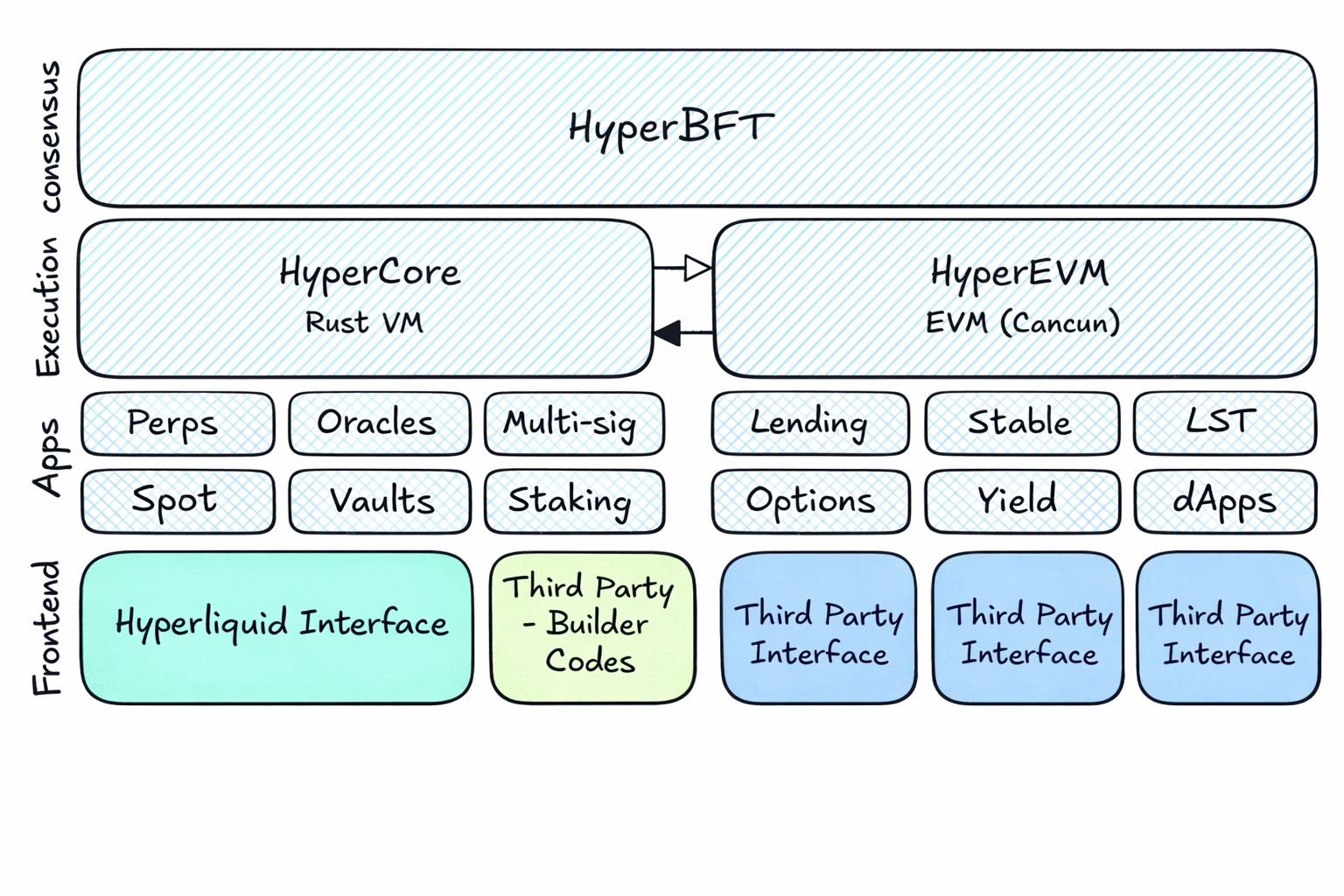
As the Hyperliquid Technical Documentation explains: "A theme of the HyperEVM is to abstract away the deep liquidity on HyperCore as a building block for arbitrary user applications." This means HyperEVM applications don't create independent settlements. They access HyperCore's existing liquidity through system precompiles and contracts.
The architectural separation between trading logic (HyperCore) and smart contract execution (HyperEVM) has direct implications for compliance monitoring. HyperCore handles all trading activities, staking, native multisigs, and core exchange functionality, while HyperEVM handles the smart contract environment. This division creates distinct economic activity zones with different risk profiles.
Why AMLBot Indexes HyperCore Only
AMLBot's decision to index HyperCore exclusively, rather than both execution layers, is driven by the concentration of economic activity, not by technical limitations. This architectural choice addresses a reality: the vast majority of Hyperliquid's economically significant transactions and AML risk occur on HyperCore, not HyperEVM.
HyperCore functions as the settlement layer for Hyperliquid's trading infrastructure. All perpetual futures positions settle on HyperCore, representing the network's core use case as a decentralized derivatives exchange. Spot trading occurs on HyperCore's on-chain order book, which features deep liquidity and high-frequency market-making. USDC deposits via the Arbitrum bridge and withdrawals—the primary mechanisms for moving value into and out of the ecosystem—transact on HyperCore. Native token staking that secures the network operates on HyperCore. These activities generate the transaction flows that compliance teams must monitor to detect suspicious patterns, sanction violations, and illicit fund movements.
Hyperliquid processes up to $30 billion in daily trading volume, virtually all of which flows through HyperCore's perpetual and spot markets rather than HyperEVM smart contracts. This separation exists because HyperCore is purpose-built for high-performance trading, with 200,000 orders per second throughput and 0.2-second finality, while HyperEVM serves as an application layer for developers building on this infrastructure.
HyperEVM's role in the ecosystem is fundamentally different from HyperCore's. Rather than creating an independent economic settlement, HyperEVM applications access HyperCore's liquidity as a building block. Smart contracts on HyperEVM interact with perpetual and spot markets on HyperCore through system precompiles, meaning that the economic substance of HyperEVM activity ultimately references HyperCore settlement. A decentralized application on HyperEVM that facilitates trading accesses HyperCore's order book, rather than creating parallel settlement infrastructure.
Industry analysis confirms this architectural relationship. As Galaxy Digital Research noted in their July 2025 analysis, activity on HyperEVM "remains modest compared to HyperCore" despite steady growth in the smart contract ecosystem. HyperEVM continues to develop in the alpha stage with a gradual feature rollout, while HyperCore handles the network's production trading volume.
From an AML risk perspective, this means that monitoring HyperCore captures the settlement layer, where economic transfers occur, while monitoring only HyperEVM captures application-layer contract interactions, which represent only a fraction of transaction volume. For compliance teams, the distinction matters because risk assessment requires visibility into actual fund movements, not just smart contract events that reference those movements.
This architectural choice allows AMLBot to deliver complete compliance monitoring with optimal resource allocation. Rather than indexing both chains and filtering out duplicate or derivative transactions, AMLBot focuses computational resources on where actual value transfer occurs.
Current Implementation: Arbitrum Bridge Monitoring
Hyperliquid's bridge architecture creates an observable chokepoint for value entering or exiting the ecosystem via the Arbitrum Bridge. Understanding this gateway mechanism is critical to AML Monitoring, as it provides complete transaction visibility for Arbitrum-based flows.
Bridge Mechanism Flow
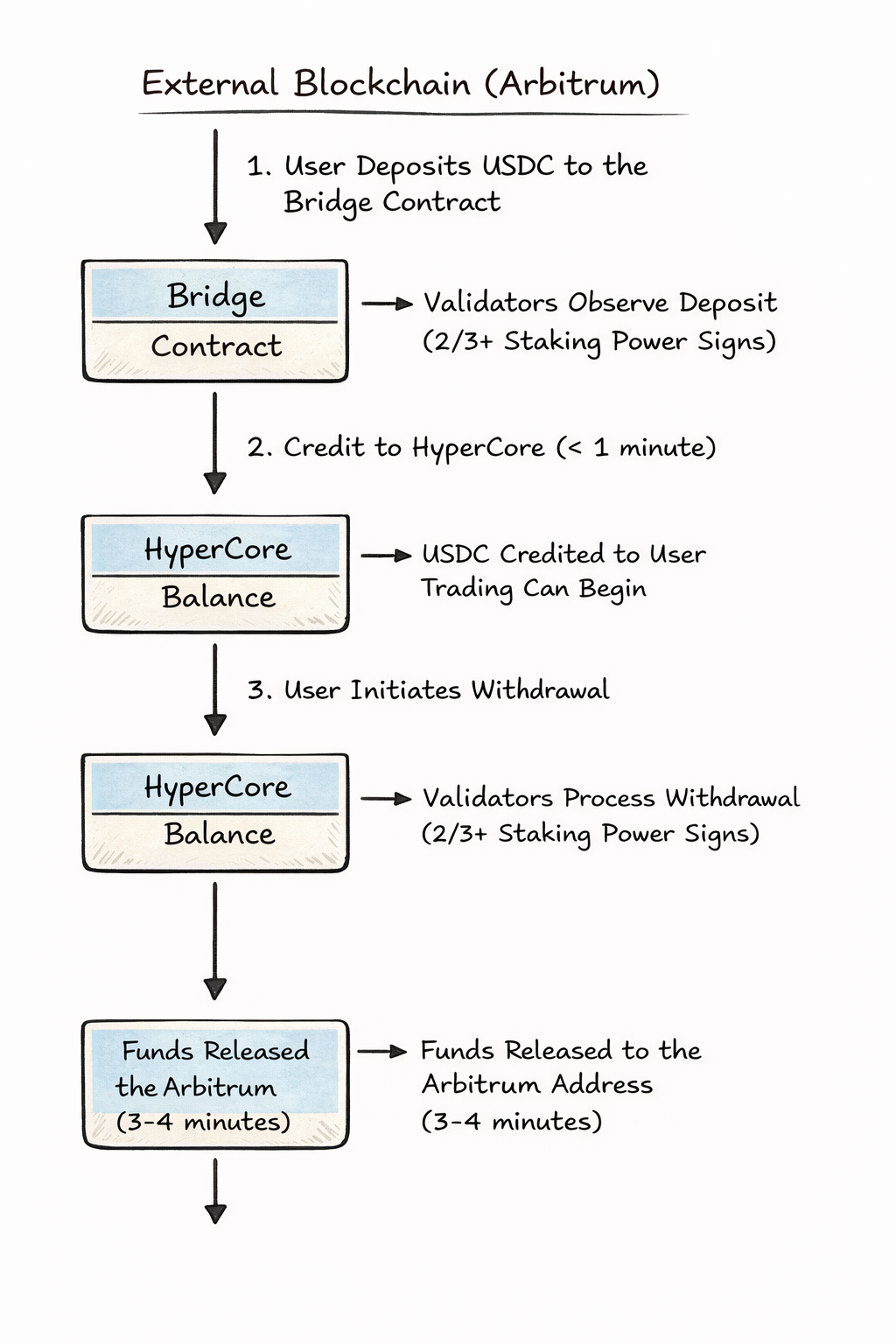
The bridge between Hyperliquid and Arbitrum requires users to send native USDC to the bridge contract, which credits the account in HyperCore in less than 1 minute with a minimum deposit of 5 USDC. Deposits are signed by validators and credited once more than two-thirds of staking power has been signed. Withdrawals on Hyperliquid require only a user wallet signature, with no Arbitrum transaction; validators handle the withdrawal entirely, and funds arrive in 3-4 minutes. USDC is the dominant settlement currency in Hyperliquid. The bridge handles USDC exclusively for native deposits; perpetual futures use USDC as collateral; spot markets predominantly quote against USDC pairs; and fee structures are denominated in USDC. This single-asset dominance means that monitoring USDC flows through the Arbitrum bridge captures the vast majority of economic activity entering or exiting Hyperliquid via this route.
AMLBot provides comprehensive monitoring for deposits and withdrawals via the Arbitrum-Hyperliquid bridge. This enables complete source-of-funds verification for Arbitrum-based flows, including: -
- Originating Ethereum Address before Arbitrum Bridge
- Complete Transaction Path on Ethereum
- Arbitrum Bridge Contract Interaction
- HyperCore Settlement and Subsequent Trading Activity
Note: Protocol Evolution (December 2025): Hyperliquid introduced Circle's Cross-Chain Transfer Protocol (CCTP) support in December 2025, enabling deposits from multiple CCTP-enabled chains including Ethereum, Polygon, Base, Avalanche, and Optimism. This represents a natural evolution of the network's gateway architecture alongside the existing Arbitrum bridge. AMLBot currently monitors deposits and withdrawals via the Arbitrum Bridge only.
Address Model and AML Labeling Compatibility
Hyperliquid's address architecture enables direct integration with existing Ethereum-based AML labeling infrastructure. This compatibility is a critical technical advantage that dramatically reduces implementation complexity.
Ethereum-Compatible Address Format
HyperCore addresses follow Ethereum's address format, using standard 20-byte hexadecimal addresses compatible with EVM wallets. The same address operates identically across HyperCore and HyperEVM, with no separate derivation or mapping required.
Example Address Usage:
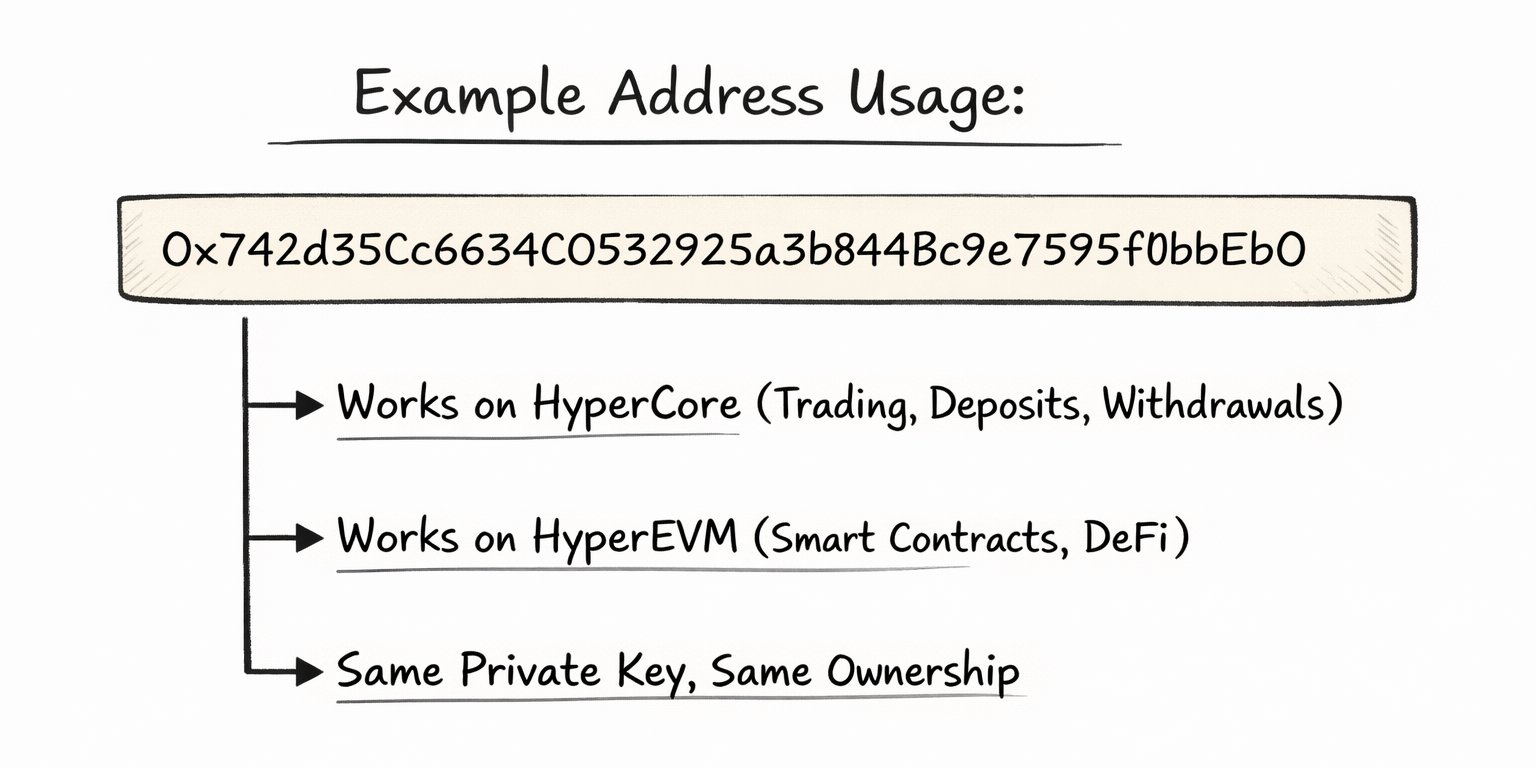
This compatibility extends beyond superficial formatting. Wallet software that supports Ethereum—MetaMask, Hardware Wallets, and Custodial Solutions—functions natively on Hyperliquid without modification. Users sign transactions using the same private keys across both chains. Address ownership verification uses the same cryptographic schemes, and transaction signing follows Ethereum's EIP-712 typed data standard.
AML Labeling Integration
For AML labeling systems, this architectural decision eliminates an entire class of technical challenges:
Direct Label Application:
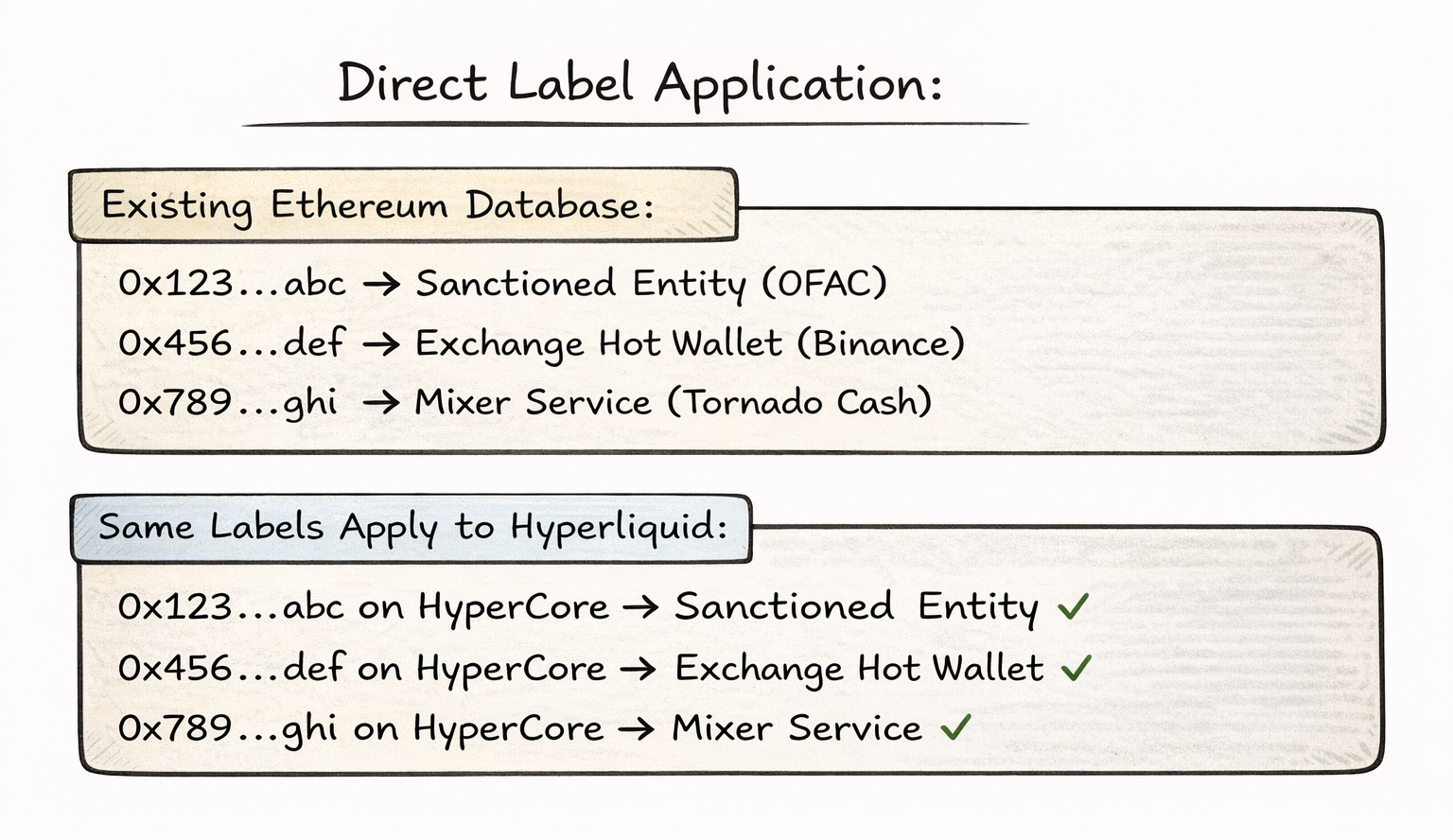
Existing address clustering algorithms developed for Ethereum apply directly to Hyperliquid without modification. Attribution databases linking addresses to entities require no separate Hyperliquid-specific entries. Behavioral analysis models trained on Ethereum transaction patterns can be applied to HyperCore activity analysis. Cross-chain investigation workflows can seamlessly track the same address across Ethereum, Arbitrum, and Hyperliquid.
When AMLBot encounters a Hyperliquid address that matches a labeled Ethereum address in its database, the attribution applies immediately. If an address previously identified as belonging to a sanctioned entity or mixer service appears in HyperCore transactions, the risk signal propagates without requiring separate verification. This address model compatibility dramatically reduces the implementation complexity typically associated with adding new blockchain support.
Transaction Types Under AMLBot Surveillance
AMLBot's Hyperliquid implementation monitors three distinct transaction categories that collectively provide complete economic visibility:
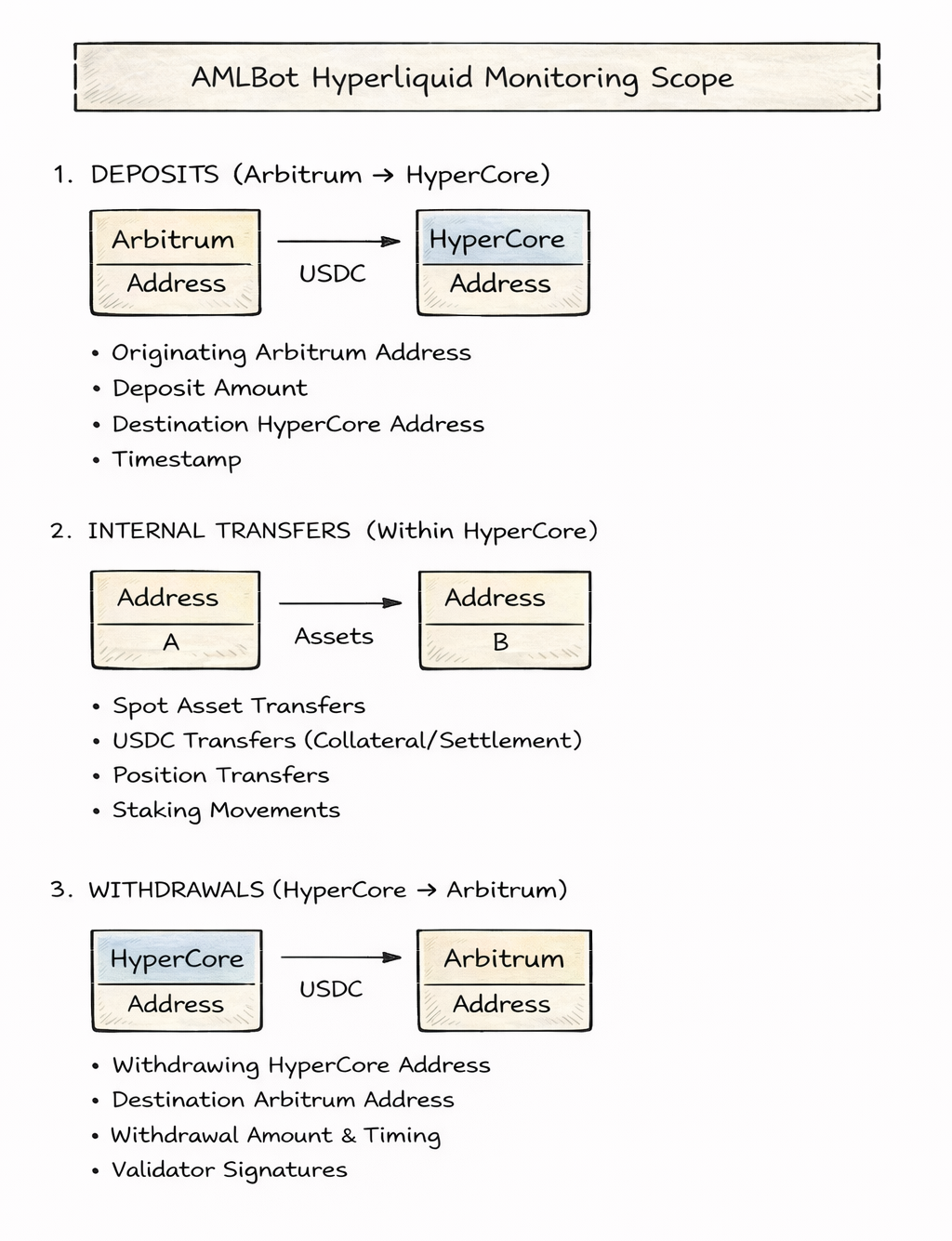
- Deposits from Arbitrum to HyperCore represent the primary value ingress vector. Users deposit USDC from their Ethereum wallets into the bridge contract on Arbitrum, and Hyperliquid validators monitor these deposits via RPC and update Hyperliquid's internal state accordingly. AMLBot captures the originating Arbitrum address, deposit amount, destination HyperCore address, and timestamp for compliance correlation. These transactions establish the initial funding source for subsequent on-chain activity.
- Transfers within HyperCore constitute the primary transaction category by volume. These include spot asset transfers between addresses, USDC transfers for collateral management or settlement, position transfers in certain protocol-supported scenarios, and native token movements for staking or governance. Internal transfers reveal the economic relationships between addresses, fund flows between trading strategies and parties, payment patterns that may indicate commercial relationships, and accumulation or distribution behaviors relevant to market manipulation detection.
- Withdrawals from HyperCore to Arbitrum complete the transaction lifecycle. Users initiate withdrawals on Hyperliquid via a UI action; validators sign the withdrawal in a two-phase protocol, and funds are released to the specified Arbitrum address once sufficient validator signatures are collected. AMLBot tracks the withdrawing HyperCore address, the destination Arbitrum address for cross-chain correlation, the withdrawal amount and timing, and validator signature patterns that may indicate irregular processing.
This three-category model provides comprehensive coverage by capturing all economically significant events. Value cannot be entered without a deposit transaction. Activity within the ecosystem generates transfer records. Exit from the ecosystem requires a withdrawal. The simplified transaction model reduces false positives compared to blockchains, where dozens of transaction types create classification challenges.
Why This Matters for Crypto Businesses
The architectural approach AMLBot employs for Hyperliquid blockchain analysis provides specific operational advantages for compliance teams handling Hyperliquid exposure.
- Teams benefit from focused architecture. AMLBot's HyperCore indexing covers all material economic activity—perpetual futures trading, spot markets, and internal transfers representing billions in daily settlement. This reduces operational complexity compared to monitoring multiple execution layers.
- Organizations using blockchain intelligence tools that monitor only HyperEVM may technically have Hyperliquid USDC deposits and withdrawals listed in their vendor capabilities, but they lack visibility into the settlement layer where the vast majority of the network's economic activity occurs. When a customer deposits funds from a Hyperliquid address, those funds almost certainly originated from HyperCore perpetual trading or spot markets—activity that HyperEVM-only monitoring cannot detect. HyperCore coverage ensures compliance teams can actually assess the risk of incoming transactions rather than simply checking a box that Hyperliquid is "supported."
- When a suspicious transaction is detected, investigators work with a limited set of transaction types rather than navigating complex DeFi protocol interactions. The gateway architecture means investigators can trace funds to their Arbitrum origin or destination, connecting Hyperliquid activity to broader Ethereum ecosystem intelligence.
- Existing Ethereum address labels apply directly without requiring Hyperliquid-specific attribution work. Compliance teams can leverage their existing counterparty databases and sanctions screening lists without building parallel infrastructure.
- By focusing monitoring resources on HyperCore, where settlement occurs, compliance teams avoid processing overhead from application-layer events that do not represent actual economic transfers. This optimization becomes critical as trading volumes scale.
The current limitation is that AMLBot does not index HyperEVM smart contract activity. For most compliance use cases, this represents acceptable coverage because economic settlement happens on HyperCore. However, as HyperEVM ecosystem applications mature and begin handling material value independently, compliance teams should anticipate expanding monitoring scope. Organizations with specific HyperEVM exposure may need supplementary monitoring, though HyperCore coverage captures the vast majority of AML-relevant activity. Importantly, the inverse is not true, organizations that monitor only HyperEVM face compliance gaps in their Hyperliquid coverage.
Hyperliquid Compliance Coverage in the Market
The Hyperliquid blockchain analysis market remains in early stages of development, with coverage that varies in comprehensiveness. While select blockchain intelligence providers have begun implementing Hyperliquid support, not all coverage approaches address the same compliance needs.
A critical distinction exists between providers that index HyperEVM versus those that index HyperCore. Some blockchain intelligence tools have added support for HyperEVM, the smart contract execution layer, positioning HyperEVM within Hyperliquid's coverage. However, this approach creates a fundamental coverage gap: HyperEVM functions as an application layer that accesses HyperCore's liquidity rather than serving as an independent settlement layer. For compliance teams, this means that monitoring HyperEVM alone captures application-layer smart contract interactions but misses perpetual futures trading, spot market activity, and USDC deposit/withdrawal flows that constitute the vast majority of actual economic settlement.
From a risk management perspective, this matters significantly. When an exchange receives a deposit from a Hyperliquid address, that value almost certainly originated from HyperCore trading activity, not HyperEVM Smart Contracts. When investigators trace illicit funds moving through Hyperliquid, the transaction trail will flow through HyperCore perpetual positions and spot markets, not HyperEVM applications. When compliance teams assess wallet risk for a Hyperliquid address, the material exposure comes from HyperCore trading volume, measured in billions per day, not from HyperEVM contract interactions.
AMLBot's HyperCore-focused architecture directly addresses this coverage gap. Rather than monitoring the application layer, where smart contracts operate, the platform indexes the settlement layer, where economic transfers occur. Combined with gateway monitoring at entry and exit points, this approach provides visibility into the transaction flows that generate real AML risk. Organizations using blockchain intelligence tools that cover only HyperEVM may believe they have Hyperliquid compliance coverage while remaining blind to the settlement layer, where most economic activity occurs.
The architectural approach matters beyond the scope of coverage. HyperCore transactions reveal trading patterns, fund flows, and economic relationships that compliance teams need to detect suspicious activity. Monitoring where billions in daily volume settle provides materially different intelligence than monitoring application-layer contract events. As Hyperliquid adoption continues to grow among institutional traders and the network attracts the attention of illicit actors, comprehensive coverage of the settlement layer is critical.
Note on Gateway Evolution: This analysis focuses on settlement layer monitoring (HyperCore vs HyperEVM). Gateway monitoring considerations, including Hyperliquid's recent CCTP multi-chain support, are addressed in the Gateway Architecture section above.

Get Access to Hyperliquid KYT Monitoring
Contact Us:
🔗 Support Team
🔗 LinkedIn
FAQ
Why Is Hyperliquid AML Monitoring Important?
Hyperliquid presents distinct compliance considerations that traditional blockchain analysis approaches may overlook. The network processes up to 30 billion dollars in daily trading volume, with high-frequency perpetual futures and spot market activity, growing adoption among institutional traders and retail users, and increasing attention from sophisticated actors both legitimate and illicit.
Hyperliquid's dual-layer architecture, consisting of HyperCore settlement and HyperEVM applications, creates coverage challenges. Monitoring only the application layer (HyperEVM) misses the settlement layer where actual economic transfers occur, creating AML blind spots.
Organizations accepting deposits from Hyperliquid addresses without proper monitoring face inability to verify source of funds (funds almost certainly originated from HyperCore trading, not visible without proper coverage), sanctions screening gaps if relying on address labels alone without transaction context, incomplete customer due diligence, and potential regulatory penalties for inadequate AML procedures.
Hyperliquid's transition from exclusive Arbitrum bridge to multi-chain CCTP support in December 2025 adds complexity to source-of-funds verification, making comprehensive monitoring increasingly critical. Additionally, high-leverage perpetual futures trading, rapid settlement finality (0.2 seconds), and high-frequency activity create distinct transaction patterns requiring specialized monitoring approaches.
How Can Hyperliquid Transactions Be Traced?
AMLBot traces Hyperliquid transactions by monitoring HyperCore, the settlement layer where economic activity occurs. Transaction types monitored include deposits via Arbitrum Bridge with complete source attribution from Ethereum through bridge contract to HyperCore, internal HyperCore transfers including spot assets, USDC movements, position transfers, and staking operations, and withdrawals to Arbitrum with full destination tracking and cross-chain correlation. Tracing capabilities include fund flow analysis across HyperCore addresses, wallet activity patterns and trading behavior, cross-chain correlation from Ethereum to Arbitrum to Hyperliquid, address attribution using existing Ethereum label databases, and risk scoring based on counterparty relationships and transaction patterns.
AMLBot indexes HyperCore deposit operations and settlement transactions, enabling investigators to trace value movements from external entry points through trading activity to exit points, providing complete visibility into economically significant flows.
Is There an AML Tool for Hyperliquid?
AMLBot provides comprehensive AML monitoring for Hyperliquid with settlement layer focus. Select blockchain intelligence providers have begun adding Hyperliquid support, but coverage approaches vary significantly. Some tools monitor only HyperEVM (the smart contract application layer), which captures application-layer interactions but misses the settlement layer where perpetual futures trading, spot markets, and the vast majority of economic activity occur.
AMLBot indexes HyperCore, the settlement layer where billions in daily trading volume flow. This architectural decision ensures visibility into the transaction types that generate real AML risk, including trading activity, deposits, withdrawals, and internal transfers, rather than application-layer smart contract events.
For organizations requiring actual transaction visibility (not just "Hyperliquid supported" checkboxes), settlement layer monitoring is essential. HyperCore coverage captures the economic activity that compliance teams must monitor to detect suspicious patterns, sanction violations, and illicit fund movements.
Does AMLBot Support Hyperliquid Blockchain?
Yes. AMLBot KYT supports Hyperliquid blockchain analysis with a focus on HyperCore, the settlement layer where perpetual futures trading, spot markets, and the vast majority of economic activity occur.
AMLBot provides: Complete HyperCore Transaction Monitoring (trading, transfers, settlements), Arbitrum Bridge gateway monitoring with full source attribution, Ethereum-compatible address labeling and sanctions screening, and cross-chain investigation capabilities linking Hyperliquid to Ethereum ecosystem. This architecture delivers comprehensive visibility into settlement-layer activity representing billions in daily trading volume.
Who Needs Hyperliquid Blockchain Compliance Monitoring?
Any organization with Hyperliquid exposure requires settlement layer visibility.
Cryptocurrency Exchanges (CEXes) listing Hyperliquid-native assets (HYPE Token, perpetual markets), accepting deposits from Hyperliquid addresses, or processing withdrawals to Hyperliquid wallets face risk because without HyperCore monitoring, they cannot verify if incoming funds originated from trading activity, potentially accepting deposits from unverified sources.
VASPs and Crypto Service providers with customers trading on Hyperliquid platform, wallet services supporting Hyperliquid addresses, or payment processors handling Hyperliquid transactions face risk because customer activity on Hyperliquid remains invisible without settlement layer coverage.
OTC Desks and Institutional Services executing Hyperliquid-related transactions, providing liquidity or market-making services, or facilitating large-value settlements face risk because they cannot assess counterparty risk without visibility into trading patterns and fund flows.
Blockchain Investigation Teams, including law enforcement tracing illicit funds, forensic analysts tracking criminal proceeds, and compliance investigators conducting enhanced due diligence, face risk because transaction trails go dark without HyperCore settlement visibility.
Financial Institutions such as banks with customers involved in crypto trading, asset managers evaluating crypto exposure, and compliance teams assessing institutional crypto adoption face risk because they remain blind to emerging high-volume trading platforms without proper coverage.
Organizations should verify that their blockchain intelligence providers monitor HyperCore (settlement layer) rather than only HyperEVM (application layer).
How Does AMLBot Handle Hyperliquid's Dual-Chain Architecture?
AMLBot indexes HyperCore exclusively because virtually all economic settlement occurs on this layer. HyperEVM applications access HyperCore's liquidity rather than creating independent settlement, making HyperCore monitoring sufficient for comprehensive AML coverage.
What Transaction Types Can AMLBot Trace on Hyperliquid?
AMLBot monitors three categories: deposits from Arbitrum to HyperCore, internal HyperCore transfers (including spot assets and USDC), and withdrawals from HyperCore to Arbitrum. This covers all material value movements in the ecosystem.
What's the Difference Between HyperCore and HyperEVM Monitoring?
HyperCore serves as the settlement layer where perpetual futures trading, spot markets, deposits, and withdrawals occur. The network processes approximately 30 billion dollars in daily trading volume on HyperCore, which exists for economic settlement and value transfer. Monitoring HyperCore captures actual fund movements and trading activity.
HyperEVM functions as the application layer handling smart contracts, DeFi applications, and custom protocols. Activity on HyperEVM "remains modest compared to HyperCore" according to Galaxy Digital Research. HyperEVM exists for application logic accessing HyperCore liquidity. Monitoring HyperEVM captures application interactions but not settlement.
For compliance purposes, monitoring only HyperEVM provides visibility into smart contract events but misses the settlement layer where economic activity occurs. For AML purposes, settlement visibility is essential because application-layer monitoring alone creates compliance blind spots.
Why Does The Arbitrum Bridge Matter For Hyperliquid AML Monitoring?
The Arbitrum bridge has historically served as the primary gateway for USDC to enter and exit Hyperliquid, creating an observable chokepoint. All meaningful fund movements pass through this bridge, providing complete transaction visibility by monitoring both bridge and HyperCore activity. Recent protocol evolution toward native USDC expands deposit routes while maintaining observable gateway architecture.
Can Existing Ethereum Address Labels Be Used For Hyperliquid Analysis?
Yes. Hyperliquid uses Ethereum-compatible addresses that work identically across HyperCore and HyperEVM. The same address labels, attribution data, and clustering algorithms developed for Ethereum apply directly to Hyperliquid without modification.
Does AMLBot Monitor HyperEVM Smart Contract Activity?
HyperCore serves as the settlement layer where virtually all of Hyperliquid's high-volume economic activity occurs—perpetual futures trading, spot market activity, and USDC deposits/withdrawals. HyperEVM functions as an application layer that accesses HyperCore's liquidity through system precompiles rather than creating independent settlements. Blockchain intelligence tools that monitor only HyperEVM capture application-layer smart contract interactions, but miss the settlement layer, where billions in daily trading volume actually flows. For compliance teams, this creates a significant blind spot—the vast majority of AML-relevant transactions occur on HyperCore, not HyperEVM.
What Makes AMLBot Different From Other Hyperliquid Analysis Tools?
AMLBot indexes HyperCore, the settlement layer where the vast majority of Hyperliquid's economic activity occurs, rather than HyperEVM, which some competitors prioritize. This architectural decision enables AMLBot to capture perpetual futures trading, spot markets, and deposit/withdrawal flows that generate real AML risk. Tools that monitor only HyperEVM provide visibility into application-layer smart contract interactions but miss the settlement layer, where billions in daily trading volume flows, creating compliance gaps for organizations that need to detect suspicious trading patterns, trace illicit fund flows, or assess wallet risk based on actual transaction volume.
Does AMLBot Monitor CCTP Deposits from Chains Other Than Arbitrum?
AMLBot currently provides comprehensive monitoring for deposits and withdrawals via the Arbitrum-Hyperliquid bridge only. CCTP deposits from Ethereum, Polygon, Base, Optimism, and other CCTP-enabled chains are not currently indexed.
CCTP deposits mint USDC on HyperEVM rather than creating HyperCore deposit operations directly. AMLBot's architecture indexes HyperCore deposit operations, not HyperEVM smart contract events. Organizations requiring immediate multi-chain CCTP source verification should contact AMLBot to discuss interim compliance procedures and implementation schedule.