Product Update: Behavioral Alerts Now Available in AMLBot KYT Dashboard
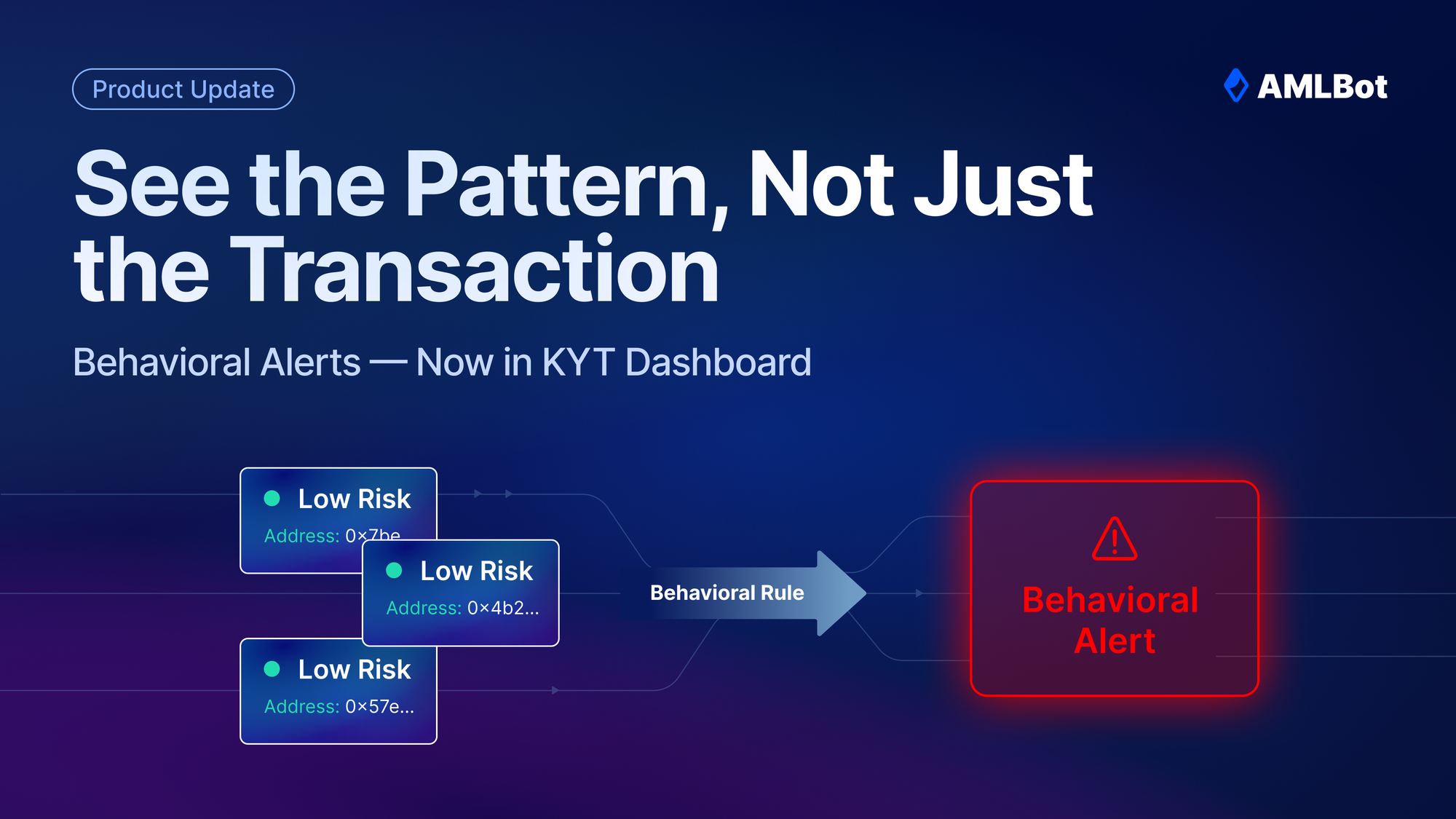
AMLBot continues to expand its KYT Dashboard capabilities to better support compliance teams in detecting and managing transaction risks. Following the recent introduction of Real-Time Transaction Alerts, which allow businesses to detect and respond to risky individual transactions as they occur, AMLBot now introduces Behavioral Alerts as the next step in monitoring.
While transaction alerts focus on risk at the level of single transfers, behavioral alerts allow compliance teams to detect suspicious activity patterns that emerge across multiple transactions over time. This new capability helps businesses to identify attempts to bypass transaction thresholds, automate pattern detection, and improve customer-level risk visibility.
The sections below explain why behavioral monitoring is becoming essential in crypto compliance and how this functionality operates within AMLBot’s KYT Dashboard environment.
Why Transaction-Level Monitoring Is No Longer Enough
Transaction Monitoring in crypto has traditionally focused on identifying risk at the level of individual transfers. Transactions are evaluated, exposure is assigned, and alerts are triggered when risk thresholds are exceeded. This model performs well when illicit activity is visible in individual events, such as direct interactions with sanctioned entities, exposure to darknet markets, mixer use, or large transfers from risky sources.
[TX] → Low Risk
[TX] → 🚨
[TX] → Low Risk
However, real-world laundering and fraud rarely occur through single, easily detectable events. In 2026, illicit activity is often structured specifically to avoid threshold-based detection. Funds are split into smaller transfers, distributed over time, routed through indirect exposure chains, or kept consistently below configured alert levels. Each transaction appears acceptable in isolation, yet the overall pattern of behavior reveals considerable risk exposure.
[TX – Low Risk] [TX– Low Risk] [TX– Low Risk] → Behavioral Rule → 🚨
Compliance Teams need tools that can identify suspicious activity patterns over time rather than merely reacting to individual transactions.
From Transaction Risk to Behavioral Risk
Behavioral Monitoring moves analytical focus from transactions to customer activity patterns. Instead of asking whether a single transaction is risky, the system evaluates whether a customer behaves in a manner consistent with laundering or risk-evading techniques.
In practice, behavioral alerts operationalize Transaction Monitoring scenarios already defined in a company’s AML and Risk Policies. These scenarios typically describe patterns such as structured deposits, repeated exposure to high-risk ecosystems, or bursts of activity inconsistent with expected customer behavior.
Traditional AML systems in banking have relied on velocity rules, structuring detection, and aggregated behavioral analysis for years. Crypto monitoring tools initially focused on address-level risk scoring. However, as regulatory expectations and compliance practices matured, regulators emphasized the need for ongoing monitoring and detection of unusual transaction patterns rather than analysis of isolated transactions. Guidance from bodies such as FATF, EU AML Frameworks, the FCA, and FinCEN requires crypto businesses to identify unusual or structured-transaction behavior and activity inconsistent with customer risk profiles.
As a result, monitoring systems evolved to incorporate behavioral logic and customizable rule engines that detect transaction patterns over time, not just individual risk events.
Behavioral Alerts in AMLBot KYT Dashboard
In AMLBot’s implementation, transactions remain the primary objects of monitoring. Customers are created automatically when transactions are added to monitoring using a Customer Identifier. Behavioral rules do not operate on wallet addresses or account entities. Instead, they evaluate transactions grouped under each customer identifier. Customers, therefore, function as aggregation containers for transaction activity rather than blockchain identity objects. Transactions belonging to the same customer may originate from any supported blockchain, and behavioral evaluation aggregates activity across chains without distinction. Rules apply globally across monitored customers, but are evaluated separately for each customer.
How Behavioral Rules Are Evaluated
Each time a new transaction enters monitoring, the system automatically checks whether the customer’s recent activity matches any behavioral rules configured by the Compliance Team. Instead of evaluating only the transaction size, the system assesses how much of the transaction is directly associated with the selected risk category. If only part of the funds is linked to risky sources, only that risky portion is counted toward the rule. This allows alerts to reflect actual exposure rather than total transfer amounts, making them easier to justify during compliance reviews.
Behavioral rules evaluate activity within a rolling time window. For example, a one-hour rule always looks back at transactions added during the previous sixty minutes. Each time a new transaction appears, the system recalculates whether the pattern now meets alert conditions. The timing is based on when transactions enter monitoring rather than blockchain confirmation time, ensuring monitoring reflects real operational conditions.
Note: As for now, rules are checked continuously without cooldown or suppression logic. This means that if suspicious activity continues, multiple alerts may be generated within the same time period. Compliance teams should therefore tune rule thresholds carefully to balance detection sensitivity and alert volume.
Monitor Behavior, Not Just Transfers → Apply to Try Behavioral Monitoring
Example Use Case: Detecting Structured Gambling Exposure
A practical example illustrates how behavioral monitoring closes gaps in detection left by transaction-level alerts. Assume deposit monitoring thresholds for gambling exposure are configured as follows:
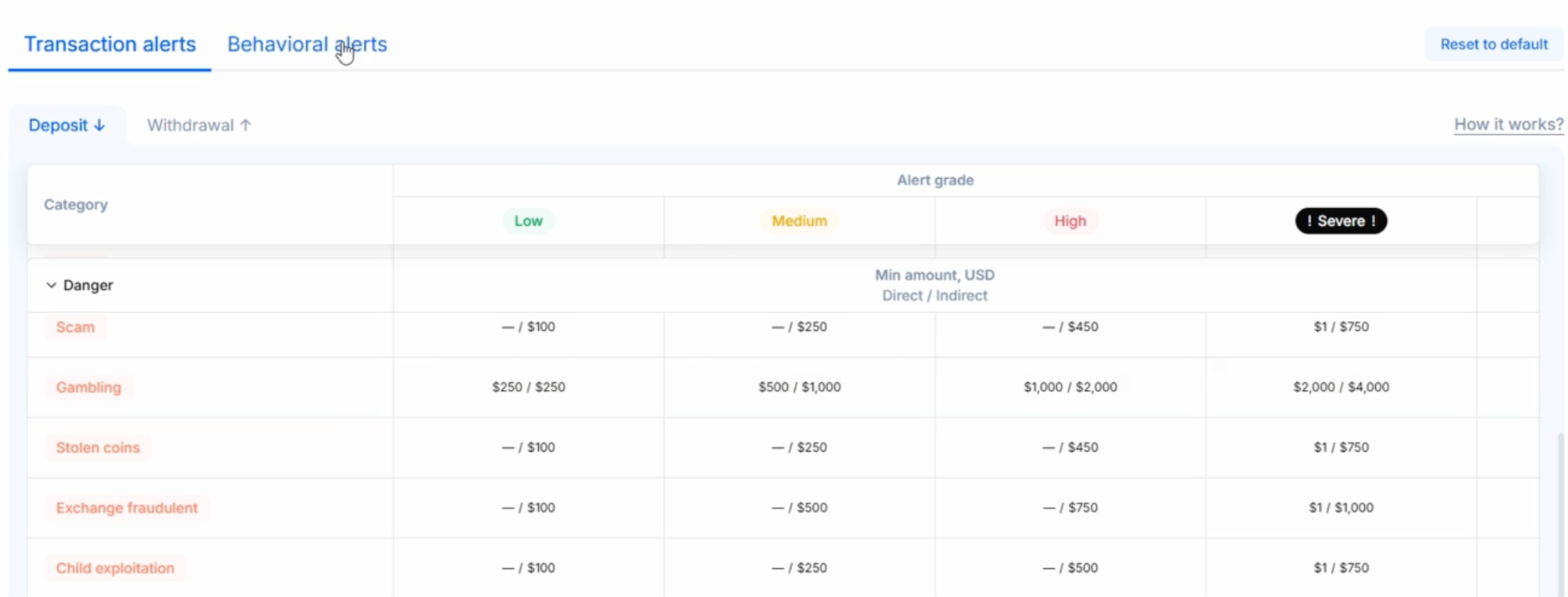
Now consider a customer who performs three deposits within one hour. The first transfer contains 160 USD gambling exposure but does not trigger a transaction alert. The second transfer contains 493 USD gambling exposure and generates a Low-Risk transaction alert. The third transfer contains 378 USD gambling exposure and again produces only a Low-risk event.
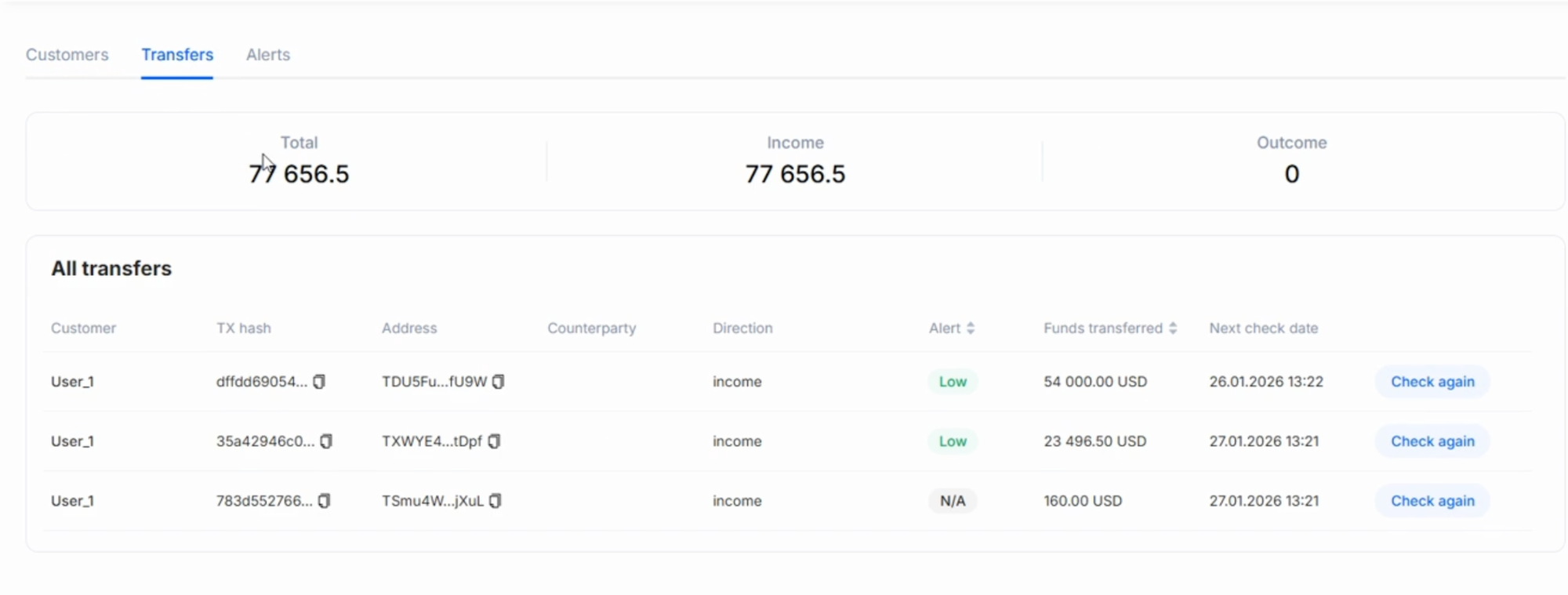
When viewed individually, none of these transactions exceeds the thresholds required to trigger higher-severity alerts. Each transfer appears acceptable in isolation, and transaction-level monitoring alone would not flag this customer as risky.
However, behavioral monitoring evaluates activity cumulatively. Instead of analyzing full transaction amounts, the system aggregates only the portion of funds linked to the selected risk category. In this case, the gambling-related exposure accumulated within one hour reaches 1,031 USD.
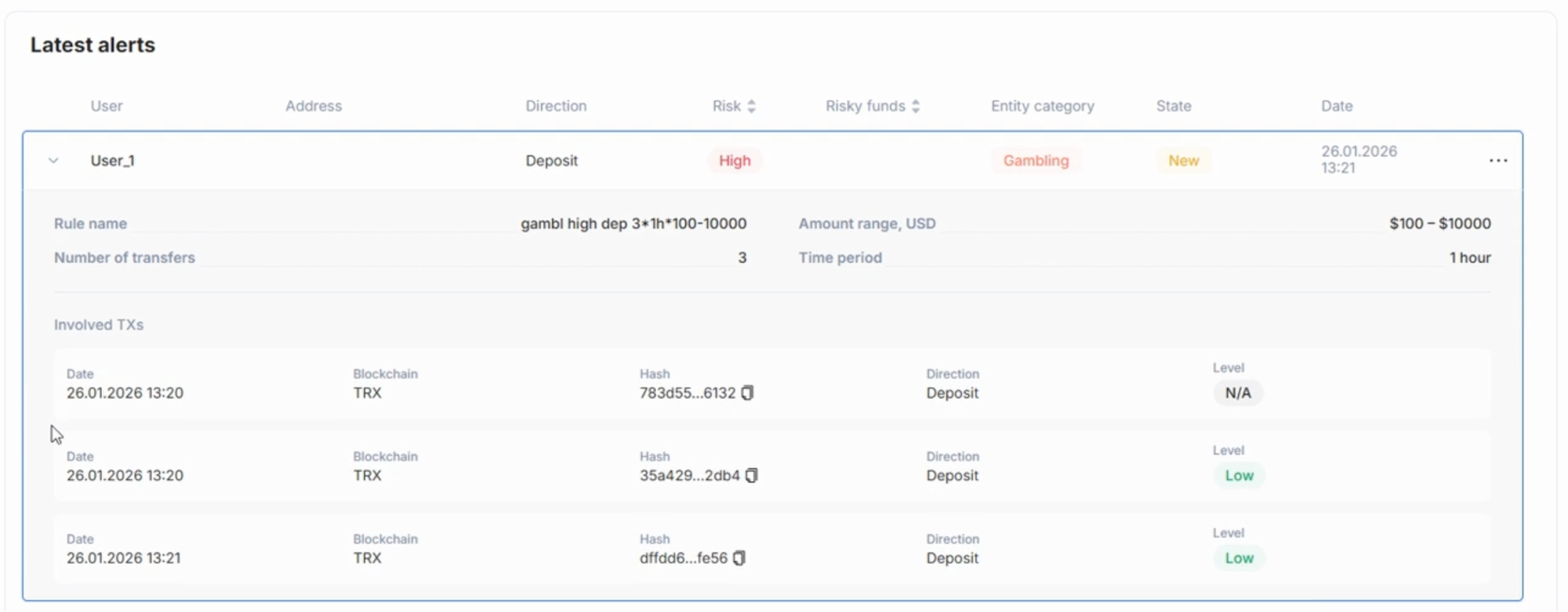
This indicates a pattern where deposits are structured to remain below configured alert thresholds while still introducing significant exposure to risky ecosystems. To detect such behavior, a behavioral rule can be configured with the following parameters:
- Category: Gambling
- Direction: Deposit
- Alert Grade: High
- Number of Transfers: 3
- Time Period: 1 Hour
- Amount Range, USD: 100–10,000 USD
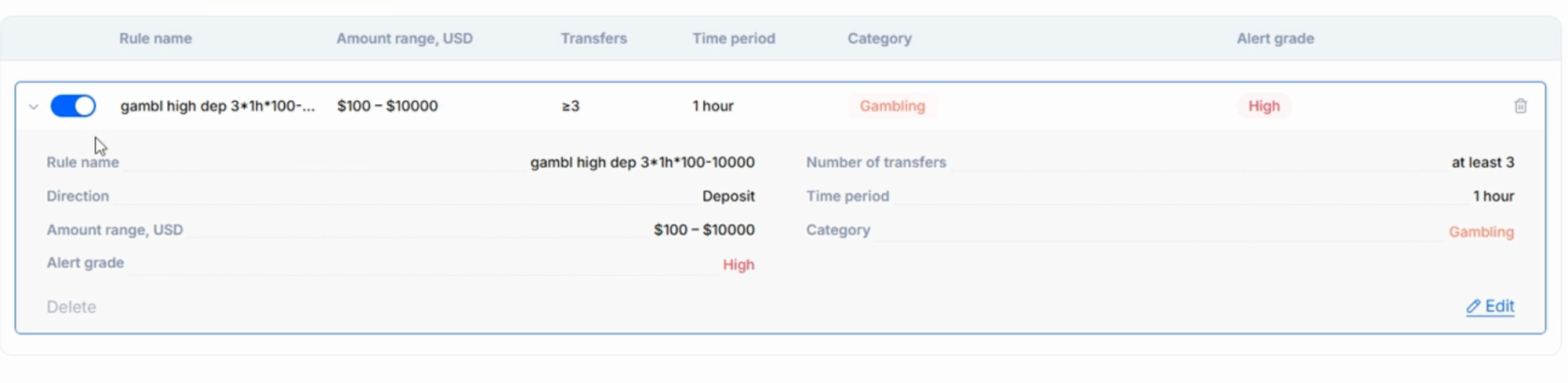
Each time a new transaction enters monitoring, the system re-evaluates recent customer activity. When the third qualifying deposit is received, the aggregated exposure within the defined time window satisfies the rule conditions, and a High-severity behavioral alert is automatically generated.
This means the alert is triggered not because a single transaction is risky, but because the customer’s behavior indicates a deliberate attempt to avoid detection through transaction splitting.
As demonstrated in the video, the alert appears immediately after the rule conditions are met, and the customer's risk level is updated accordingly, allowing compliance teams to investigate the activity without manually reconstructing transaction history.
Why Behavioral Alerts Matter for Compliance Teams
- (a) Detection of attempts to bypass transaction thresholds. Customers may try to avoid detection by splitting risky funds into multiple smaller transfers. Behavioral Alerts allow teams to identify suspicious patterns across several transactions, even when individual transfers appear harmless.
- (b) Reduced reliance on manual transaction analysis. Instead of analysts manually reviewing transaction histories to identify suspicious behavior, the system automatically evaluates activity and generates alerts when configured patterns are detected.
- (c) Continuous monitoring of customer behavior. The system monitors activity in real time, enabling teams to respond quickly when behavior changes or risk exposure accumulates over time.
- (d) Flexible rule configuration based on business risk appetite. Compliance teams can configure multiple behavioral rules aligned with internal policies and specific business risks, adjusting sensitivity depending on operational needs.
- (e) Centralized monitoring workflow. Rules, transactions, and alerts are managed in a single interface, reducing operational friction and allowing teams to investigate suspicious activity faster.
The Next Stage of KYT Monitoring
The broader trajectory of crypto compliance monitoring is moving from reactive transaction screening toward proactive behavioral risk detection. Instead of evaluating whether a transaction is risky, compliance operations focus on whether a customer’s activity pattern represents risk.

FAQ
What Is Behavioral Monitoring in Crypto Compliance?
Behavioral Monitoring is a compliance approach that evaluates customer activity patterns across multiple transactions over time, rather than assessing risk at the level of individual transfers. It enables compliance teams to detect suspicious behaviors such as transaction structuring, threshold evasion, and repeated exposure to high-risk ecosystems — patterns that may not be visible when transactions are reviewed in isolation.
What Is the Difference between Transaction Alerts and Behavioral Alerts?
Transaction Alerts are triggered when a single transfer exceeds a configured risk threshold. For example, when a deposit carries significant exposure to sanctioned entities or darknet markets. Behavioral Alerts, on the other hand, are triggered when a pattern of activity across multiple transactions matches a predefined rule. For instance, several individually low-risk deposits may collectively indicate structuring if they accumulate significant exposure to a specific risk category within a short time window.
Why Is Transaction-Level Monitoring Not Enough for Crypto AML?
Modern laundering and fraud techniques are often designed to bypass transaction-level detection. Funds are split into smaller transfers, distributed over time, or kept below configured alert thresholds. Each transaction may appear low-risk individually, but the overall pattern reveals deliberate risk evasion. Without behavioral monitoring, compliance teams may miss structured activity that only becomes visible when transactions are analyzed together.
How Do Behavioral Alerts Work in AMLBot KYT Dashboard?
Behavioral Alerts in AMLBot KYT Dashboard are evaluated each time a new transaction enters monitoring. The system checks recent customer activity against behavioral rules configured by the compliance team. Rather than evaluating total transaction amounts, the system aggregates only the portion of funds directly associated with the selected risk category within a rolling time window. When the accumulated exposure meets rule conditions — such as a defined number of transfers, amount range, and time period — a Behavioral Alert is automatically generated.
What Behavioral Rules Can Be Configured in AMLBot KYT?
Compliance teams can configure Behavioral Rules based on several parameters: risk category (e.g., gambling, sanctions, darknet), transaction direction (deposit or withdrawal), alert severity grade, minimum number of qualifying transfers, time period (rolling window), and exposure amount range in USD. Multiple rules can be active simultaneously, allowing teams to align detection logic with their internal AML Policies.
How Can Behavioral Alerts Detect Structured Deposits in Crypto?
Structured deposits occur when a customer splits risky funds across multiple smaller transfers to stay below alert thresholds. Behavioral Alerts detect this by aggregating risk-specific exposure across transactions within a defined time window. For example, if three deposits each carry moderate gambling exposure that individually falls below alert levels, but the combined exposure within one hour exceeds a configured threshold, the system triggers a high-severity behavioral alert — flagging the pattern as a potential structuring attempt.
Do Regulations Require Behavioral Monitoring for Crypto Businesses?
Regulatory bodies including FATF, the EU AML framework, the FCA, and FinCEN emphasize the need for ongoing monitoring and detection of unusual transaction patterns, not just one-time screening of individual transfers. Guidance requires crypto businesses to identify structured transactions and activity inconsistent with customer risk profiles. Behavioral Monitoring helps businesses meet these expectations by automating pattern detection across customer activity over time.