Web3 Gaming AML Compliance: Player KYC, Wallet Screening, and In-Game Asset Monitoring
In a traditional game, value stays inside. A player earns a sword, a skin, or in-game currency — and it remains on the platform, usable only within the game, non-transferable, and ultimately controlled by the developer. In a Web3 game, the same sword may be an NFT on Ethereum, purchasable with USDT, tradable on an in-game marketplace, transferable to another player, withdrawable to an external wallet, and convertible to fiat through an exchange. The same value crosses at least four different systems — player account, blockchain, marketplace, and external service — before it leaves the ecosystem.
This is what makes Web3 gaming AML fundamentally different from both traditional gaming compliance and standard crypto exchange compliance. The value does not sit in one place. It moves between player accounts, connected wallets, internal balances, game tokens, NFTs, marketplace orders, and external addresses — sometimes changing form at each step. A deposit becomes a game token. A game token buys an asset. The asset is sold to another player. The proceeds are withdrawn to a new wallet.
No single check — not KYC alone, not wallet screening alone, not blockchain analytics alone — can follow that full chain. Effective Web3 gaming AML requires the platform to connect player identity, wallet roles, funding sources, in-game asset movement, marketplace activity, and withdrawal destinations into a single, continuous view of how value enters, moves through, and leaves the game.
This article explains which Web3 gaming models create AML exposure, how value moves through a gaming platform, what data compliance teams need to connect, how to approach player KYC, wallet screening, and in-game asset monitoring, and what gaming-specific alerts look like in practice.
Which Web3 Gaming Models Create AML Exposure?
AML exposure in Web3 gaming depends not on whether the platform uses blockchain or NFTs, but on what financial functions it performs and how users can move value. The FATF assesses virtual asset services through the functions an entity performs — transfer, exchange, safekeeping, administration. MiCA uses its own CASP definitions. Neither framework classifies a platform based on whether it calls itself a "game."
- Closed-loop game assets — points, credits, or items that exist only inside the game, cannot be withdrawn to an external wallet, cannot be traded on an external market, and cannot be exchanged for crypto or fiat — generally create less crypto-specific AML exposure because value does not move freely between the game and the broader blockchain ecosystem. This does not mean the platform has no obligations at all — payment fraud, account abuse, sanctions concerns, and consumer protection issues may still apply.
- Non-custodial Web3 games — where players connect their own wallets, sign transactions themselves, and hold assets in personal wallets — require careful analysis. The term "non-custodial" does not automatically answer the regulatory question. What matters is whether the platform controls smart contracts, can modify or stop transfers, operates a marketplace, performs matching or settlement, collects fees for facilitating transactions, participates in transferring assets between users, or can restrict withdrawals or asset movement. The actual role of the platform matters more than the technical label.
- Custodial, marketplace, and cash-out models create the most direct AML exposure. Functions that typically increase exposure include custody or control over user assets, internal player balances, accepting crypto deposits, executing withdrawals, transferring assets on behalf of users, operating a player-to-player marketplace, escrow, matching buyers and sellers, marketplace settlement, exchanging game tokens for other crypto assets, conversion to stablecoins or fiat, redemption of game assets, and distributing rewards to external wallets. A single platform may combine several of these models — for example, gameplay may be non-custodial, but marketplace settlement or reward distribution may be controlled by the platform.
NFTs and game assets deserve a specific note. The name "NFT" does not by itself exclude AML relevance. MiCA excludes truly unique and non-fungible crypto-assets from its scope, but the actual properties and usage of the asset remain important. Relevant factors include whether the asset can be freely transferred, whether a secondary market exists, whether it can be exchanged for other crypto, whether it is used to transfer value, whether it is genuinely unique, whether large series of functionally interchangeable assets exist, and whether the user can cash out through it.
How Value Moves Through a Web3 Gaming Platform
Before examining individual AML controls, it helps to understand the full lifecycle of value on a Web3 gaming platform.
- Funding. Value enters the game through an external wallet, centralized exchange, fiat purchase, token transfer, NFT deposit, bridge or external protocol, or platform-distributed reward.
- In-game use. Inside the platform, value may become an internal balance, game token, NFT, character, land, weapon, marketplace purchase, upgrade or crafted asset, or reward.
- Player-to-player movement. Value can be transferred through direct asset transfer, marketplace sale, gift, guild or team account, internal balance transfer, asset swap, or escrow settlement.
- Withdrawal and external cash-out. Value leaves the platform through token withdrawal, NFT withdrawal, marketplace proceeds, stablecoin conversion, redemption, reward payout, transfer to an exchange, or transfer to an external wallet or protocol.
The critical insight is that AML control should not be limited to deposit and withdrawal. Between those endpoints, value can change hands between players, change form between assets, move between internal ledger and blockchain, be split across accounts, or return to the original holder. A simplified flow looks like this: External Funding → Player Account → Internal Balance or Asset → Gameplay or Marketplace Activity → Transfer or Sale → Withdrawal.
What Data Web3 Gaming AML Needs to Connect
Web3 gaming compliance cannot be built on a KYC provider, a wallet screening tool, or a game analytics dashboard alone. It requires connecting data from multiple systems.
- Player and account context includes the stable player or customer ID, KYC status, verification date, account creation date, jurisdiction indicators, customer risk level, account type, transaction and withdrawal limits, known linked accounts, previous alerts, active restrictions, previous enhanced reviews, and relevant changes in player profile. The stable player ID is critical — a player may change wallets, add funding wallets, use a separate payout wallet, interact across multiple networks, and have multiple permitted game profiles. AML history should not reset with each new address.
- Wallet and blockchain context includes connected wallet, funding wallet, payout wallet, blockchain network, transaction hash, sender, recipient, token contract, asset type, amount, estimated value, transaction direction, timestamp, wallet risk result, direct and indirect exposure, and known entity attribution. Each address must be stored with its role — login wallet, funding source, reward recipient, marketplace counterparty, payout destination, or platform-controlled operational wallet. An address without a role does not explain the transaction flow.
- Asset, marketplace, and game event context includes asset ID, token contract, asset type, minting event, previous owner, ownership history, reward event, purchase, sale, player-to-player transfer, marketplace order ID, buyer player ID, seller player ID, listing price, execution price, upgrade or crafting event (where it affects value), internal balance movement, refund, and withdrawal request. The same on-chain transfer could represent a gameplay reward, marketplace settlement, direct player transfer, withdrawal, refund, treasury distribution, or operational platform movement. Without the event ID and player context, these transactions look identical.
Consider a practical example: blockchain analytics shows a transfer of a game token from Address A to Address B. Internal data additionally shows that Address A belongs to Player 1, the transaction followed a marketplace sale, Address B is Player 2's payout wallet, the asset previously moved between these players, and the marketplace proceeds were soon withdrawn. This context does not prove laundering — but it enables meaningful review.
Player KYC: Who Should Be Verified and When?
Player KYC connects an account to a verified identity. It is distinct from registration (which creates the player account), wallet screening (which evaluates blockchain activity but does not confirm identity), and ongoing KYC (which keeps customer information current over time).
- Which players may need KYC depends on applicable law and the product model. Functions where KYC is especially relevant include custodial accounts, crypto deposits, internal transferable balances, player-to-player marketplaces, external withdrawals, higher transaction limits, asset redemption, conversion to another crypto asset or fiat, and commercial seller or professional marketplace activity. Not every user needs full KYC immediately after installing the game — but not every platform can defer KYC until withdrawal either. The timing depends on applicable requirements and the specific functions available to the player.
- Risk-based verification and reverification triggers include the first significant crypto funding, activation of custodial functionality, connecting a new payout wallet, substantial limit increases, a sharp rise in transaction volume, changes in transaction patterns, use of multiple linked accounts, mismatch between profile and actual activity, new sanctions or AML signals, expiry or change of identity information, and the player moving into a higher risk category. Ongoing KYC means updating customer information when risk or circumstances change — not repeating full onboarding after every transaction.
- Linking identity to multiple accounts and wallets requires that verification is tied to a stable customer or player ID. When a player connects a new wallet, previous account history is preserved, alerts and reviews are not reset, the wallet is added to the existing customer context, its role is recorded, and additional screening is performed where needed. Linked accounts may exist for permitted reasons — multiple profiles, household use, guild structure, shared custody provider, or one user controlling several accounts. A shared wallet address may belong to a centralized exchange, a custodial provider, or a guild treasury. One shared address does not prove coordinated laundering.
Wallet Screening: Which Addresses and Transactions Should Be Checked?
Wallet screening should focus on the financial role of a specific wallet and transaction, not on every technical connection of an address to the game.
- Wallet roles that matter for AML include connected or login wallet, funding wallet, wallet from which an NFT was sent, reward recipient, marketplace counterparty, payout wallet, exchange deposit address, and platform-controlled wallet. A login wallet does not necessarily fund the account. A funding wallet is not necessarily used for withdrawal. A payout wallet may belong to an exchange or custodial service. One player may change wallets; one address may be used by multiple accounts for legitimate reasons. Screening results must be connected to the specific transaction flow.
- When wallet and transaction screening is needed includes the first external crypto funding, a new wallet participating in financial activity, a substantial deposit, receipt of an external NFT or other asset, marketplace transactions, withdrawals, payout wallet changes, unusual connections between player accounts, new risk triggers, and periodic rescreening based on the risk model. Wallet screening evaluates an address and its history; transaction screening evaluates a specific asset movement; ongoing monitoring identifies changes and related sequences over time.
- How screening results should be interpreted requires considering the specific risk category, direct versus indirect exposure, distance and timing of exposure, known service or entity, amount, asset, transaction direction, funding source, destination, player profile, previous activity, wallet role, and related game or marketplace event. Wallet screening does not confirm the owner's identity, does not prove illegal origin, does not explain economic purpose, and should not lead to identical decisions for every medium- or high-risk result. Interaction with a self-hosted wallet, DEX, or bridge does not by itself mean high risk — what matters is the specific source, destination, protocol, exposure, and overall transaction context.
In-Game Asset and Player Behavior Monitoring
This is the layer that KYC and wallet screening alone cannot cover. Monitoring must analyze sequences of activity, movement of transferable assets, relationships between players, marketplace behavior, and the connection between gameplay events and funding or withdrawal.
Value movement with limited gameplay context may be indicated by external funding followed by rapid withdrawal of comparable value, purchasing an asset and quickly transferring it to another account, receiving assets without corresponding game events, repeated purchase and resale without a clear gameplay function, marketplace proceeds withdrawn shortly after a trade, regular receipt and transfer of assets without expected gameplay activity, transaction volume sharply different from previous behavior, or a game account used primarily as a route for moving value. The relevance of limited gameplay depends on the game model — it may be normal for a marketplace-focused product and unusual for a game where valuable assets are typically earned through extended play. Limited or absent gameplay is contextual information, not independent evidence of money laundering.
Linked accounts and coordinated value transfers may include multiple accounts using one funding wallet, players withdrawing to a common payout address, accounts trading only with each other, identical sequences of funding, purchase, transfer, and withdrawal, assets circulating among a fixed group, value distributed across accounts before withdrawal, a guild or intermediary account collecting and distributing assets, or multiple accounts receiving assets from one external source. A shared wallet may belong to a centralized exchange, custodial provider, guild treasury, household, or one user with multiple permitted accounts. One shared address does not prove coordinated laundering.
Abnormal marketplace and wash-trading signals may include assets sold significantly above or below comparable sales, buyer and seller regularly trading with each other, assets returning to a previous owner, series of reciprocal trades, repeated transfer cycles, sharp price changes between linked accounts, marketplace volume inconsistent with player profile, proceeds quickly withdrawn after a sale, or an asset used to transfer a predetermined value. Review should connect buyer and seller player IDs, wallets, asset ID, ownership history, listing and execution prices, comparable sales, buyer's funding source, subsequent movement of proceeds, and previous trades between the parties. An unusual price is a reason for review, not proof of wash trading — the value of a unique game asset may depend on rarity, utility, scarcity, visual characteristics, upgrade level, or gameplay functions.
Asset lifecycle monitoring means tracking not just token transfers but the full lifecycle of a specific asset: minting, initial distribution, reward, purchase, upgrade or crafting, player-to-player transfer, marketplace listing, sale, repeated resale, withdrawal, and burn or redemption. The asset ID should allow linking the current owner, previous owners, related orders, transaction prices, linked player accounts, and subsequent withdrawal of proceeds. Especially important are circular ownership, repeated movement within one group, rapid changes of owner, and mismatch between asset history and stated economic purpose.
How Web3 Gaming AML Alerts Should Be Reviewed
A wallet risk result or an unusual marketplace event alone is not enough to make a compliance decision. The analyst needs gaming-specific context.
- Player context. Who the player or customer is, whether required KYC is complete, the account's risk level, whether linked accounts exist, which wallets were used previously, whether there were prior alerts or restrictions, and whether current activity is consistent with past behavior.
- Wallet and transaction context. Which wallet sent the value, where it is going, what role each address plays, whether direct or indirect exposure exists, whether the address is linked to a known entity, and whether other player accounts are involved.
- Asset and game context. Which asset is involved, how the player obtained it, who was the previous owner, what the ownership history shows, which game event explains the transaction, whether there were upgrade, crafting, or reward events, and whether asset movement is consistent with the product's mechanics.
- Marketplace context. Who the buyer and seller are, how the parties are connected, what the listing and execution prices were, whether comparable sales exist, whether trades repeated, whether the asset returned to a previous owner, and where proceeds were directed.
- Economic purpose. The central question is whether the available player, wallet, asset, marketplace, game, and blockchain context provides a reasonable explanation for the movement of value. A reasonable explanation does not guarantee absence of risk, but it helps distinguish normal gameplay from legitimate marketplace activity, from platform or data error, from game abuse, from fraud, from sanctions exposure, and from suspicious movement of value.
It is important to distinguish AML, fraud, and game abuse. Bots, cheating, and reward farming may be game abuse. Account takeover and fake asset sales may be fraud. Movement of potentially illicit value, concealment of routes, or coordinated cash-out may create AML concern. Sanctions exposure may require separate escalation regardless of a broader laundering pattern. A security incident becomes AML-relevant if stolen assets pass through game accounts, marketplace, or withdrawal flows. Reward farming by itself may be game abuse; if linked accounts are funded from a shared high-risk source, trade assets between themselves, and withdraw proceeds to one wallet, the activity additionally requires AML review.
Building AML Controls Across the Player Lifecycle
The following table maps the main control points across the player lifecycle:
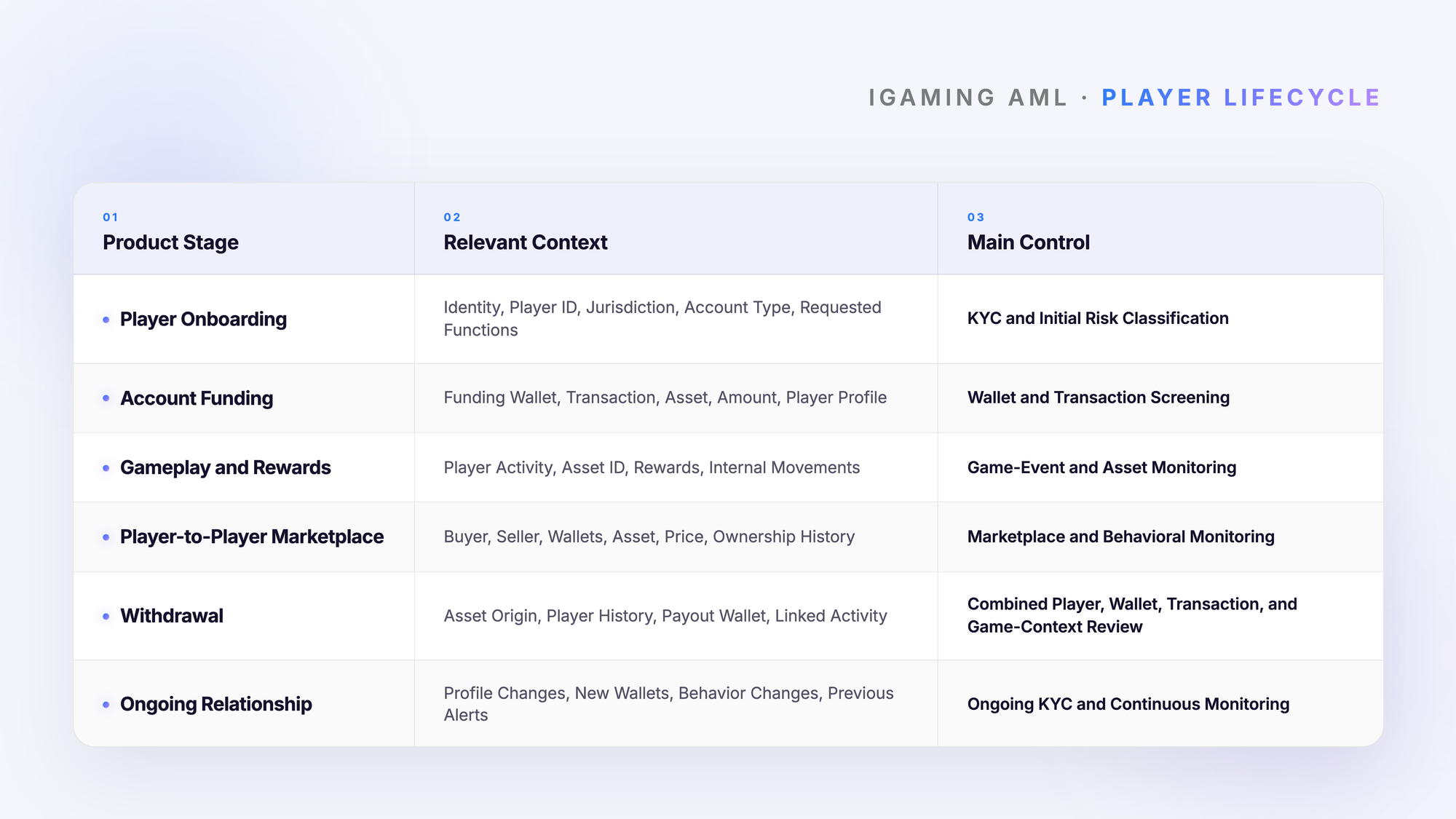
Four principles underpin an effective Web3 gaming AML framework.
- Stable player identity. All accounts, wallets, alerts, and reviews should be maintained around a stable player or customer ID — not rebuilt from scratch each time a wallet changes.
- Wallet role mapping. The platform should distinguish connected, funding, counterparty, and payout wallets — because the same address serves different functions at different stages.
- Game event-to-transaction mapping. Each relevant blockchain transaction should be linked to a specific reward, purchase, sale, transfer, refund, or withdrawal event — so that on-chain data and in-platform data can be read together.
- Separate but connected escalation paths. AML, fraud, sanctions, security, and game abuse should have different decision criteria, but relevant information should flow between teams. A sanctions hit on a funding wallet and a pattern of reward farming are different problems — but they may involve the same player and the same value flow.
Conclusion
Web3 gaming AML does not start with screening every wallet or requiring KYC from every registered player. It starts with understanding the platform's actual financial functions — which assets can store and transfer value, where value enters the system, how it moves between players and assets, and where it can leave.
After that, controls should connect verified identity, stable player account, known wallets, funding source, blockchain transactions, in-game assets, gameplay events, marketplace activity, and withdrawal destinations into a continuous, reviewable chain.
Each control has limitations. KYC confirms identity but does not explain the source of assets. Wallet screening evaluates blockchain exposure but does not show gameplay purpose. Blockchain analytics tracks value movement but cannot see internal game events. Game data explains in-platform activity but does not always reveal the external source or destination. A monitoring signal requires review but is not automatic proof of money laundering.
Effective Web3 gaming AML depends on understanding the platform's actual financial functions and maintaining a continuous link between the player, the wallet, the in-game asset, the game event, and the resulting movement of value.
FAQ
Do All Web3 Gaming Platforms Need AML Compliance?
Not every Web3 game has the same AML obligations. The applicable requirements depend on the platform's functions, jurisdiction, control over user assets, transferability of in-game assets, and whether users can deposit, trade, exchange, or withdraw value.
When Can a Web3 Gaming Platform Be Considered a VASP or CASP?
A platform may require VASP, CASP, or another regulated-service assessment when it provides functions such as custody, crypto transfers, exchange, marketplace settlement, redemption, or withdrawals on behalf of users. The legal classification depends on the applicable jurisdiction and the platform's actual role, not simply on whether it describes itself as a game or a non-custodial application.
Does Every Web3 Gaming Player Need to Complete KYC?
Not necessarily. The timing and scope of mandatory KYC depend on applicable law and the functions available to the player. Verification may become particularly relevant when users access custody, transferable balances, player-to-player trading, higher limits, asset redemption, or external withdrawals.
Is Connecting a Crypto Wallet Enough to Identify a Player?
No. A connected address does not by itself prove who owns or controls the wallet. The platform should link verified identity, player account, known wallets, wallet roles, previous activity, and relevant reviews through a stable player or customer ID.
Which Wallets Should a Web3 Gaming Platform Screen?
Screening may be relevant for funding wallets, wallets sending external assets, marketplace counterparties, reward recipients, payout wallets, and other addresses involved in financial activity. A wallet used only to log in should not automatically be treated as the player's funding or withdrawal wallet.
What Is the Difference Between Player KYC and Wallet Screening?
Player KYC verifies the identity associated with an account. Wallet screening assesses blockchain activity, transaction history, known entity links, and risk exposure, but it does not establish the identity of the wallet owner or prove the source of funds is lawful.
How Should Web3 Games Monitor In-Game Assets for AML Risk?
Platforms should connect asset IDs, ownership history, rewards, purchases, transfers, marketplace orders, prices, counterparties, and withdrawals. Monitoring should focus on linked sequences of activity rather than treating a single asset transfer or marketplace sale as conclusive evidence of suspicious behavior.
What Web3 Gaming Activity May Require Additional AML Review?
Potential indicators include rapid funding and withdrawal, circular asset transfers, repeated trades between linked accounts, unusual marketplace pricing, coordinated use of funding or payout wallets, and movement of value without an expected game-related explanation. These indicators are review triggers, not automatic proof of money laundering.
Does an Unusual NFT or In-Game Asset Price Prove Wash Trading?
No. The price of a unique game asset may be affected by rarity, utility, scarcity, upgrade level, visual characteristics, or gameplay functions. Pricing becomes more relevant when combined with repeated trades, linked buyers and sellers, circular ownership, or rapid withdrawal of proceeds.
Is Using Multiple Player Accounts an AML Red Flag?
Multiple accounts may be relevant, but they do not automatically indicate money laundering. Accounts can be connected for legitimate reasons, including guild activity, household use, shared custody services, or permitted additional profiles, so the relationship must be assessed together with funding, trading, asset, and withdrawal patterns.
Does a Non-Custodial Web3 Game Have No AML Risk?
No. A non-custodial design reduces some forms of platform control but does not automatically remove regulatory or AML considerations. The assessment should examine whether the platform facilitates transfers, controls smart contracts, operates marketplace settlement, receives transaction fees, or otherwise participates in the movement of value.
What Information Is Needed to Review a Web3 Gaming AML Alert?
An analyst may need the player ID, KYC status, account history, wallet roles, transaction data, asset ID, ownership history, related game events, marketplace order, buyer and seller information, pricing context, funding source, and withdrawal destination. The goal is to determine whether the combined data provides a reasonable explanation for the movement of value.