
AMLBot Academy EU DAC8 Directive Explained: Crypto Tax Reporting Rules for CASPs DAC8 is no longer a future compliance project. The first EU crypto reporting period began on 1 January 2026, and the technical plumbing arrived just before it: Commission Implementing Regulation (EU) 2025/2263, published in the Official Journal on 26 November 2025, set the standard forms and computerized formats for
Product Updates Featured AI Tracer (Beta): The First Self-Serve Crypto Investigation Tool Built for Everyone Imagine. Your crypto was stolen ten minutes ago. You have a transaction hash. You know the funds are moving. But by the time you try to start figuring out where they're going, the thief has already crossed two bridges and split the funds across a dozen wallets. Speed
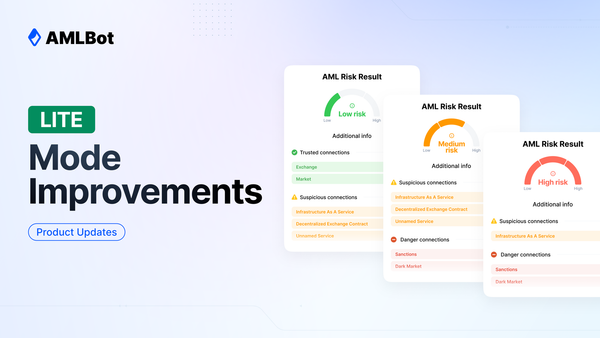
Product Updates Clearer Risk Levels and Consistent Scoring Across All Modes Lite Mode was designed as the easiest way to check crypto wallet risk — fast, affordable, and accessible for individuals who want quick answers before interacting with an address. Soon, we're releasing an update that improves how risk signals are interpreted in Lite Mode while keeping the experience just
AMLBot Academy How to Avoid Crypto Scams in 2026: Warning Signs and Prevention Checklist Crypto scam losses reached an estimated $12 billion in 2024, and in 2025 that number climbed past $14 billion on-chain. The trend heading into 2026 is clear: crypto fraud is growing faster than the crypto market itself. While scammers often tailor their approach to older adults and people with
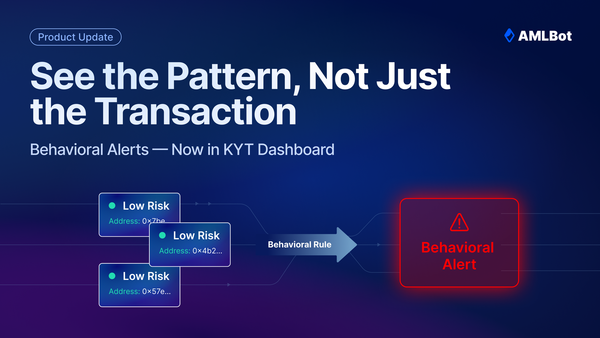
Product Updates Product Update: Behavioral Alerts Now Available in AMLBot KYT Dashboard AMLBot continues to expand its KYT Dashboard capabilities to better support compliance teams in detecting and managing transaction risks. Following the recent introduction of Real-Time Transaction Alerts, which allow businesses to detect and respond to risky individual transactions as they occur, AMLBot now introduces Behavioral Alerts as the next
AMLBot Academy Cross-Chain Analysis Explained: Tracing Crypto Across Multiple Blockchains The modern crypto ecosystem spans hundreds of blockchains operating in parallel. Fund flows rarely remain within a single network: assets move between chains through bridges, decentralized exchanges, and wrapped token systems. Each transfer across a network boundary breaks transaction continuity. A movement that starts as ETH on Ethereum may appear
AMLBot Academy US Crypto Travel Rule: FinCEN Requirements for Crypto Businesses Travel Rule violations are the most commonly cited infraction under the Bank Secrecy Act (BSA) — the primary US Anti-Money Laundering Law — identified by the Internal Revenue Service (IRS) during examinations of Money Services Businesses (MSBs) engaged in convertible virtual currency transmission. (Source: Kenneth A. Blanco, FinCEN Director, Blockchain Symposium,
AMLBot Academy Wallet and Entity Identification in Blockchain Analytics INTRO A blockchain ledger records every transaction, but it never tells you who is behind an address. It shows that 0x7a3f… sent 14.2 ETH to 0xb8c1…, yet reveals nothing about whether those strings belong to an individual, an exchange, or a sanctioned mixer. Multiply this by the billion-plus
AMLBot Academy Crypto Transaction Tracing: Fund Flow Analysis Explained When you look up a wallet on a block explorer, you can see individual transactions — amounts, addresses, timestamps. But that's not the same as understanding where money actually came from or where it ended up. Transaction tracing goes further. It reconstructs the full movement of funds across multiple
Product Updates AMLBot Adds Hyperliquid Blockchain Support (Hyperliquid's Settlement Layer HyperCore) AMLBot KYT solution has expanded its blockchain coverage to include Hyperliquid, a high-performance decentralized exchange that operates its own Layer 1 Blockchain. This addition addresses a critical compliance gap: while Hyperliquid's trading volume and total value locked continue scaling, comprehensive blockchain intelligence coverage for the network'
AMLBot Academy Crypto Travel Rule Implementation: Key Challenges for Crypto Businesses The Crypto Travel Rule is no longer a distant regulatory concept. In an increasing number of jurisdictions, it is an enforceable obligation, and virtual asset service providers are expected to demonstrate compliance in practice, not merely in policy documents. Yet the gap between regulatory intent and day-to-day operations
AMLBot Academy EU Crypto Travel Rule: How the Regulation Applies to Crypto-Asset Service Providers (CASPs) The financial regulatory landscape of the European Union has undergone a transformation with the introduction of the new Anti-Money Laundering (AML) package, specifically targeting the sector of digital assets. Central to this transformation is the implementation of the EU Crypto Travel Rule, codified under Regulation (EU) 2023/1113, also
AMLBot Academy How EU AMLR Changes KYC Obligations for Crypto Businesses Summary: The EU's Anti-Money Laundering Regulation has entered into force, but its obligations for obliged entities generally apply from 10 July 2027. In September 2026, EU crypto businesses remain subject to the existing AML framework alongside MiCA and the already applicable Transfer of Funds Regulation, while AMLA
Partnerships AMLBot and Kazakhstan’s Department for Combating Cybercrime Establish a Framework for Cooperation in Crypto Crime Investigations AMLBot has entered into a Memorandum of Collaboration with the Department for Combating Cybercrime (DC3) of the Ministry of Internal Affairs of the Republic of Kazakhstan, the national law-enforcement authority responsible for investigating organized cybercrime and financial crime. The growth of digital assets has transformed criminal behavior: funds move
AMLBot Academy Crypto Regulations in the UK 2025 — Post‑Brexit Framework for Digital Assets, AML & FCA Licensing Summary: A UK crypto business in late 2026 is subject to two regulatory timelines at once. Today, FCA registration under the Money Laundering Regulations remains the operative requirement for in-scope cryptoasset firms, alongside the Travel Rule (in force since 1 September 2023), the financial promotions regime (since 8 October
AMLBot Academy KYC Service Providers: How to Compare and Choose the Right Provider Put three KYC provider websites side by side and the feature lists look almost identical: document verification, biometrics, sanctions screening, global coverage, API, AI-powered fraud detection. Run the same 1,000 customers through all three and the results will not be. Completion rates differ, as do legitimate-user rejections,
AMLBot Academy MiCA License Explained: CASP Requirements, Authorization Process, and EU Passporting Summary: "MiCA license" is the market term. The legal concept is authorization as a Crypto-Asset Service Provider under Regulation (EU) 2023/1114. The EU-wide transitional period ended on 1 July 2026, so legacy national VASP status no longer provides a basis for continuing MiCA-regulated services.
AMLBot Academy US Crypto Regulations 2026: AML, Stablecoins, SEC/CFTC, and State Licensing TL;DR: U.S. crypto regulation is still split between federal and state authorities, and no single agency resolves a business's full compliance scope. But the picture has changed materially. FinCEN and the Bank Secrecy Act still supply the core AML framework for businesses that qualify as money
Product Updates Real-Time Alerts: The Alarm System Behind AMLBot’s Transaction Monitoring Over 40% of wallets flagged as high-risk were once considered safe. Risk exposure changes fast — and response time is everything. A transfer can pass a check today and be tied to a sanctioned entity tomorrow. Independent 2024 Industry Research found that more than 50% of risky wallets were identified
AMLBot Academy Crypto KYC Requirements: Global Standards for VASPs and CASPs Japan's crypto Travel Rule does not apply to every outbound transfer. It applies to transfers going to service providers in a specific list of jurisdictions that Japan has assessed as having equivalent rules — 58 of them, plus five more added with effect from 3 August 2026: Anguilla, Botswana,
AMLBot Academy Crypto Compliance in 2026: AML Regulations for Crypto Businesses In 2026, crypto compliance is no longer a question of whether obligations apply — it is a question of which set of obligations applies to your business, where, and when. Crypto businesses now operate inside a network of concrete, dated requirements: FATF standards and the Travel Rule globally, the final MiCA
AMLBot Academy How to Recover Stolen Cryptocurrency: 5 Practical Steps Can stolen cryptocurrency be recovered? Occasionally. Blockchain transactions cannot simply be reversed. Recovery usually depends on where the funds move next. If they reach an exchange, custodian, stablecoin issuer, or another identifiable service, there may be a party capable of freezing or preserving the assets. If they stay in self-
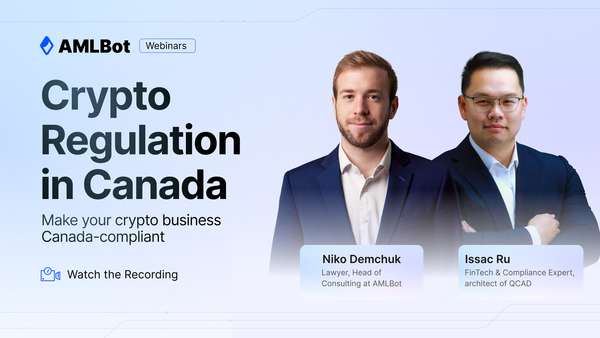
Webinars Webinar Replay: Crypto Regulation in Canada 🇨🇦 🎙️ Hosted by AMLBot | September 9, 2025 | 👨⚖️ Speaker: Niko Demchuk 🎤 Guest: Issac Ru, Architect of the first regulated Canadian stablecoin, FinTech & Compliance Expert Canada has become one of the most talked-about G7 markets for crypto — not because it copied the EU or US, but because it built its own
Product Updates Earn with AMLBot: Public Referral Program is Live After months in invite-only mode, our Referral Program is now open to everyone! If you’ve ever purchased an AMLBot package or have completed an AML check, you can start earning today. 👉 Grab your personal referral link, share it, and earn a share of the revenue from every paid
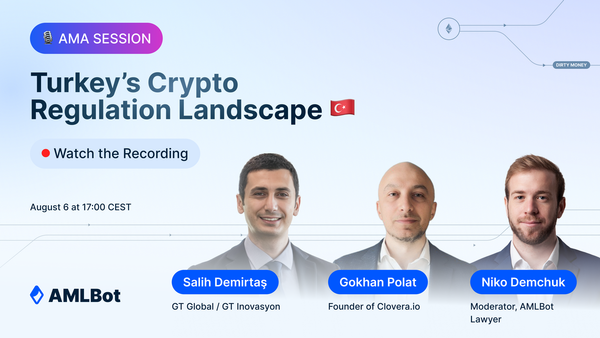
Webinars Webinar Replay: Crypto Regulation in Turkey 🇹🇷 🎙️ Hosted by AMLBot | August 6, 2025 | 👨⚖️ Speaker: Niko Demchuk 🎤 Guests: Salih Demirtaş (GT İnovasyon), Gökhan Polat (Clovera.io) In 2025, Turkey introduced a sweeping regulatory framework for crypto, from strict licensing to AML rules and stablecoin limits. But many questions remain. That’s why we asked Salih Demirtaş and Gokhan