AI Agent Stablecoin Payments: Who Is Responsible for AML Compliance?
A software agent finds a paid API. It evaluates the price, determines that the data is needed to complete its task, selects a provider, and initiates a stablecoin payment. The USDT leaves the wallet. The provider confirms receipt and returns the data. The agent continues with its work.
The blockchain records that stablecoins moved from one address to another. It does not record who authorized the payment, what task the agent was performing, why this particular provider was selected, what spending limit applied, whether the destination wallet was screened, whether anyone reviewed the transaction before it was signed, or whether the payment matched the conditions the agent was given.
These are not theoretical questions. As AI agents increasingly interact with payment infrastructure — including protocols like x402, which enables machine-readable stablecoin payments for API access and digital services — the separation between "who decided" and "what moved on-chain" becomes a practical compliance problem. The blockchain shows the transfer. Everything else — the customer, the authority, the purpose, the controls — must come from the people and businesses that set the agent in motion.
The central question this article addresses: who is responsible for AML compliance when software selects a counterparty and initiates a stablecoin transfer on behalf of a person or business?
The answer is not the agent. Software can execute a payment. It cannot own the AML responsibility. Responsibility remains with the natural and legal persons that authorize, control, facilitate, or process the payment — the customer, the agent operator, the wallet provider, and the recipient.
How an AI Agent Stablecoin Payment Works
The basic sequence of an agent-initiated stablecoin payment follows a defined flow. An individual or business gives the agent a task. The agent receives specific payment permissions. The agent finds a service or counterparty. The agent receives a payment request, price, or invoice. A wallet or signing infrastructure creates and signs the transaction. Stablecoins are transferred to the recipient. The service provider confirms payment and delivers the product, data, API access, or other resource.
In simplified form: Customer or Business → Agent → Payment Mandate → Wallet or Signing Provider → Stablecoin Transfer → Merchant or Service Provider.
Three models describe how much authority the agent holds in this flow.
- Human-approved payment. The agent prepares the transaction, but a human separately confirms the recipient and amount before execution. The agent selects; the human authorizes.
- Mandate-based payment. The agent can pay independently within pre-established boundaries — approved purposes, permitted recipients or categories, allowed assets and networks, amount limits, frequency caps, and time constraints. The agent operates within rules; the rules are set by the business.
- Dynamic counterparty selection. The agent independently selects the provider and payment destination as part of completing a broader task. The agent chooses the counterparty; the mandate defines what choices are acceptable.
These models differ not in whether AML obligations exist, but in how much decision authority has been delegated to software. The more decisions the agent makes, the more important the mandate, wallet controls, policy enforcement, counterparty identification, transaction records, and human-review triggers become.
Who Is the Customer and What Has the Agent Been Authorized to Do?
Before distributing AML responsibility, three things must be established: who the agent acts for, what authority it has been given, and whose funds it uses.
- The customer or business principal is the natural or legal person on whose behalf the agent performs its task. This may be an individual user, a company, a developer purchasing API services, a corporate treasury, a merchant, a platform customer, or another verified business. For individual flows, the agent must be linked to a specific customer account. For business flows, verified legal entity, authorized representative, UBO information, business activity, expected payment purpose, funding source, and customer risk profile may all be relevant. The agent does not become the customer simply because it technically sends the transaction. Identity and risk history must be maintained at the level of the real customer or business principal.
- The agent identity and payment mandate define the agent's technical footprint and operational boundaries. The agent should have a technical identity — agent ID, application ID, customer account ID, agent operator, task or session ID, software version, permission set, and execution credential — linked to the customer it serves. This identity allows the compliance team to determine which agent initiated a payment, on behalf of which customer, during which task, with which permissions, and under which policy version.
The payment mandate defines what the agent is authorized to do with funds: permitted purpose, allowed goods or services, permitted recipients or categories, allowed stablecoins, blockchain networks, maximum amount per transaction, cumulative spending limit, frequency, validity period, geographic restrictions, prohibited counterparties, conditions requiring human approval, and revocation conditions. A general instruction like "find and buy the best available dataset" is not a payment mandate — it does not define the acceptable price, permitted provider, asset, network, limit, or approval conditions.
Wallet control and signing authority must be separately established. Who owns the stablecoins? Who controls the wallet? Where are the private keys held? Who can sign a transaction? Can the agent initiate a transaction independently? Can it also sign? Is the wallet hosted or self-hosted? Does one wallet serve multiple customers or agents? Can the provider stop or reject a payment? The wallet address alone does not show the owner of the funds, the authorized user, the scope of agent authority, or the payment purpose.
Who Is Responsible for AML Compliance in an Agent Payment?
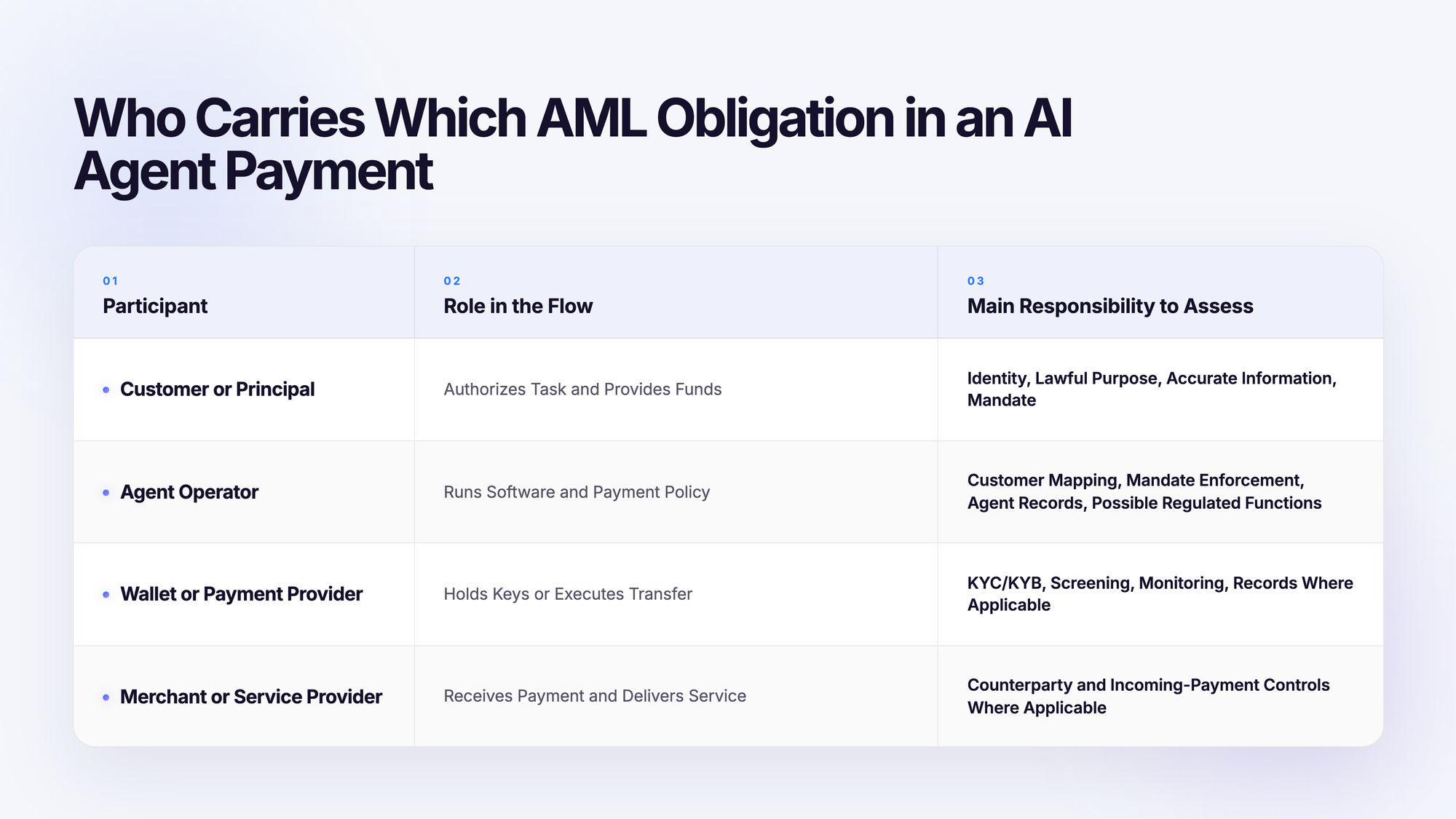
An AI agent does not take on AML obligations in place of people and businesses. In a single payment flow, separate obligations may apply to the customer or principal, the agent operator, the wallet provider, the custodian, the payment facilitator, the exchange or conversion provider, and the merchant or service provider. Which party has formal AML obligations depends on the applicable jurisdiction, customer relationship, custody, control over funds, signing authority, transfer execution, exchange, settlement, payment processing, and counterparty relationship.
- The customer or principal provides funds, defines the task, authorizes the use of the agent, and establishes or accepts spending rules. They must provide accurate identity and business information and may need to explain payment purpose or source of funds. But an ordinary customer does not automatically become an obliged entity or need to run a full AML program — the distinction is between responsibility for lawful use and accurate information on one hand, and the formal AML obligations of a regulated service provider on the other.
- The agent operator or application provider — the company that develops or provides the agent, manages the customer account, stores the mandate, sets the payment policy, selects wallet infrastructure, transmits instructions for signing, may select the recipient, and collects fees — must be assessed based on its actual functions. Does it only provide software? Does it hold customer funds? Does it control keys? Can it change the recipient or amount? Does it execute transfers on behalf of customers? Does it manage pooled wallets? Does it perform exchange or settlement? Can it approve, stop, or reject a transaction? The label "AI platform," "agent provider," or "non-custodial application" does not determine compliance status by itself.
- Wallet, custody, and payment providers — entities that create hosted wallets, hold keys, execute signing, broadcast transactions, convert assets, facilitate stablecoin transfers, perform settlement, or process payments — may carry their own AML obligations depending on their model and jurisdiction: KYC/KYB, sanctions and PEP screening, wallet and transaction screening, ongoing monitoring, Travel Rule processes, source-of-funds review, recordkeeping, alert review, and suspicious activity escalation. But using a regulated wallet or payment provider does not mean the agent operator can stop maintaining its own customer, mandate, and transaction context.
- The merchant or service provider — the party receiving the stablecoin payment (API provider, data provider, cloud service, digital marketplace, another agent operator, or crypto business) — must understand who the contractual customer is, what product or service is being paid for, how the payment relates to the order or request, which wallet actually sent the funds, whether an intermediary is involved, and which incoming-payment controls apply. A merchant who only accepts payment for its own service and a payment processor who handles funds for many merchants perform fundamentally different functions.
The following table summarizes the distribution:
Where AML Controls Must Apply in the Agent Payment Flow
Before payment authority is enabled, the business must establish the customer or business principal, KYC/KYB status, customer risk level, authorized user, source of wallet funding, known funding wallets, allowed assets, permitted networks, expected payment purpose, spending limits, allowed counterparty categories, geographic restrictions, human-approval triggers, and mandate validity and revocation conditions. Agent payment capability should not exist separately from a verified customer account and a defined policy.
Before each stablecoin payment, the system must link the payment request to the customer ID, agent ID, mandate, task or order, source wallet, destination wallet, stablecoin, network, amount, merchant or service, and payment purpose. Controls at this point include destination wallet screening, transaction screening, sanctions screening, counterparty attribution, asset and network policy check, transaction limit check, cumulative spending check, human-approval requirement, duplicate or replay check, and consistency with the order, invoice, or resource. The result should map to a clear outcome: approve, approve and monitor, require human confirmation, hold for review, reject, or escalate.
The agent should not independently interpret a raw AML risk score and improvise a decision. The business must translate risk results into an approved policy: which results allow execution, which require review, which block payment, and who can override.
After settlement and during ongoing activity, the business must save the transaction hash, link it to the customer and agent, connect it to the mandate and task, record the actual amount and recipient, confirm settlement status, match the payment to the delivered service, save the screening result, count the payment toward aggregate customer and agent activity, continue monitoring, re-screen when risk exposure changes, and generate alerts on new risk signals. Blockchain confirmation proves settlement — it does not confirm legitimate purpose or compliance.
What Data Must Connect the Agent Decision to the On-Chain Transfer
The blockchain transaction proves that stablecoins moved. Internal records must explain who authorized the payment, why the agent made it, which controls were applied, and what was actually purchased.
Customer and authorization context includes customer or business ID, KYC/KYB status, customer risk level, authorized representative, agent ID, agent operator, task or session ID, mandate ID, payment purpose, permission set, spending limits, mandate validity, policy version, human-approval requirement, and amendment or revocation history. Policy version matters because a review must reference the rules in effect at the time of payment, not only the current rules.
Payment and counterparty context includes source wallet, destination wallet, role of each wallet, stablecoin, blockchain network, amount, timestamp, merchant or provider, service or product, order ID, invoice ID, API resource or request ID, quoted price, actual payment amount, contractual recipient, actual on-chain recipient, and relevant intermediary. It is especially important to compare the provider selected by the agent, the entity named in the invoice or request, and the wallet that actually received the stablecoins.
Screening, execution, and outcome context includes wallet screening result, transaction risk result, sanctions result, entity attribution, direct or indirect exposure, triggered policy rule, automated decision, human reviewer (if any), approval or override, signing provider, transaction hash, blockchain status, payment error or exception, evidence that service was delivered, and refund, cancellation, or dispute.
The complete chain: Customer → Mandate → Agent → Payment Request → Screening Decision → Wallet Signature → On-Chain Transaction → Service Delivery.
Which AI Agent Payment Patterns Require AML Review?
The following patterns are specific to or especially important for delegated payment execution — not a repeat of general crypto AML red flags.
- Payments outside the mandate include transactions exceeding per-transaction limits, aggregate spending exceeding total budget, payments inconsistent with approved purpose, use of prohibited assets or networks, selection of unauthorized recipients, transactions after mandate expiry or revocation, absence of required human approval, splitting a single purchase across multiple payments, and multiple individually permitted payments that together violate cumulative limits. A payment outside the mandate is first an authorization or control failure. It becomes AML-relevant when combined with suspicious counterparties, unexplained movement of value, concealment, repeated circumvention, splitting, or high-risk wallet exposure.
- New or changing counterparties include a new destination wallet, a recipient different from the provider selected by the agent, a wallet changing between quote and payment, payment directed to an intermediary, a service using many unrelated wallets, payment going to a different jurisdiction, an actual recipient not matching the invoice or order, and the agent constantly selecting new providers without clear business reason. Review should compare the service endpoint, merchant identity, contractual counterparty, destination wallet, entity attribution, agent selection record, and previous payment history. A wallet change is not automatically a red flag — exchanges, payment processors, and other services may use rotating deposit addresses.
- Repeated, split, and circular payment flows include high volumes of micropayments, repeated payments for one service, payments just below internal approval limits, one task paid to multiple recipients, multiple agents sharing a funding wallet, one recipient receiving funds from many related agents, refunds to a different wallet, funds moving between related agent operators, stablecoins returning to the principal through a different address, and payment volume inconsistent with actually delivered services. High-frequency micropayments may be normal for API requests, data, compute, or digital resources — so the analysis should consider aggregate value, purpose, frequency, recipient relationships, delivered services, customer profile, wallet connections, and final destination.
How to Review a High-Risk Agent-Initiated Payment
- Reconstruct the payment from authorization to settlement. The analyst should establish who authorized the agent, which mandate applied, what the agent was attempting to purchase, which recipient was expected, who controlled and signed from the wallet, which checks were performed, what result each check produced, who received the stablecoins, whether the service was actually delivered, and whether anything in the flow deviated from the mandate.
- Compare the expected and actual payment flow. Was the recipient the same as the one the agent selected? Did the amount match the quoted price? Was the correct asset and network used? Was the payment within limits? Was human approval required and obtained? Did the screening result allow execution? If any element diverges, the analyst should determine whether the divergence indicates an error, a configuration issue, a fraud event, or a suspicious movement of value.
- Distinguish AML risk from other categories. Unauthorized credential use, recipient substitution, or payment after mandate revocation may begin as a security or fraud incident. These become AML-relevant when funds then pass through high-risk wallets, are split, converted, or used for further movement of value. AML, fraud, and sanctions may involve the same transaction but require different escalation paths.
- Case records for agent payments should include the customer, agent ID, mandate, task, payment purpose, source and destination wallets, counterparty, screening results, policy decision, signing provider, transaction hash, delivered service, and analyst reasoning — in addition to the standard alert documentation.
Conclusion
When software sends stablecoins, the AML question is not whether the agent is compliant. It is whether the people and businesses behind the agent — the customer who authorized the task, the operator who set the rules, the provider who executed the transfer, and the recipient who received the funds — have maintained a clear connection between the customer, the mandate, the wallet, the compliance decision, and the on-chain transaction. Each participant's obligations depend on the functions they actually perform, not on the label they use. A customer provides identity and lawful purpose. An agent operator enforces the mandate and maintains records. A wallet or payment provider applies screening and monitoring. A merchant applies incoming-payment controls. None of these responsibilities transfer to the agent itself. Software can send the stablecoins. It cannot own the AML responsibility.
FAQ
Who Is Responsible When an AI Agent Sends Stablecoins?
The software agent itself does not take legal or AML responsibility. Responsibility remains with the people and businesses that authorized the agent, provided or controlled the funds, operated the payment infrastructure, executed the transfer, or received the payment. The exact obligations depend on each participant's functions and the applicable jurisdiction.
Is an AI Agent Considered the Customer in a Crypto Payment?
Usually, no. The customer or principal is the individual or legal entity on whose behalf the agent acts. The agent should be treated as a technical actor linked to that customer, not as a substitute for customer identification.
Does an AI Agent Need Its Own KYC Verification?
Usually, no. The customer or principal is the individual or legal entity on whose behalf the agent acts. The agent should be treated as a technical actor linked to that customer, not as a substitute for customer identification.
What Is a Payment Mandate for an AI Agent?
A payment mandate defines what the agent is authorized to purchase, which assets and networks it may use, how much it may spend, which counterparties are permitted, how long the authority remains valid, and when human approval is required.
Is a General Instruction Enough to Authorize an Agent Payment?
Not always. A broad instruction such as "buy the best available service" may not define the maximum price, permitted recipient, stablecoin, network, spending period, or approval conditions. Agent payments require a sufficiently specific mandate and enforceable payment policy.
Does Using a Non-Custodial Wallet Remove AML Obligations?
No. A non-custodial design does not automatically remove regulatory or compliance considerations. The assessment should examine who controls the customer relationship, payment mandate, transaction instructions, smart contracts, signing process, transfer execution, and settlement.
What Should Be Screened Before an AI Agent Sends Stablecoins?
Relevant checks may include the destination wallet, transaction risk, sanctions exposure, counterparty attribution, permitted asset and network, spending limits, cumulative activity, payment purpose, and consistency with the related order, invoice, API request, or service.
Can an AI Agent Make AML Decisions Based on a Wallet Risk Score?
An agent should not independently interpret a raw risk score unless the business has converted the result into an approved decision policy. The policy should define which results allow execution, require human review, trigger additional checks, or block the payment.
What Information Should Connect an Agent Decision to a Blockchain Transaction?
The audit record may need to connect the customer, agent ID, mandate, task, payment purpose, source and destination wallets, counterparty, screening results, policy decision, signing provider, transaction hash, and evidence that the expected service was delivered.
Must a Company Store the AI Model's Chain of Thought?
No. AML records should preserve decision-relevant evidence, such as the inputs used, applicable mandate, policy rules, selected action, approvals, transaction details, and outcome. A company does not need to store or reconstruct the model's private internal reasoning.
Are Frequent AI Agent Micropayments Suspicious?
Not by themselves. High-frequency payments may be normal when agents purchase API requests, data, compute, or other metered services. Review should consider aggregate value, payment purpose, counterparties, customer profile, delivered services, and whether payments appear designed to bypass limits.
What Agent Payment Patterns May Require AML Review?
Potential indicators include payments outside the mandate, repeated transfers just below approval limits, unexplained changes in recipient wallets, payments inconsistent with the purchased service, circular transfers, shared funding across related agents, refunds to unrelated wallets, and movement through high-risk counterparties.
Is a Payment Outside the Agent Mandate Automatically Money Laundering?
No. It may first indicate an authorization, configuration, operational, fraud, or security failure. It becomes more relevant to AML when combined with suspicious counterparties, unexplained economic purpose, concealment, repeated circumvention, splitting, circular movement, or high-risk wallet exposure.
How Should a High-Risk Agent-Initiated Payment Be Reviewed?
The analyst should reconstruct the flow from the principal's instruction to settlement: who authorized the agent, which mandate applied, what the agent attempted to purchase, which recipient was expected, who controlled and signed from the wallet, which checks were performed, who received the stablecoins, and whether the service was delivered.
Can One Agent Payment Create Several Types of Risk?
Yes. A compromised agent payment may simultaneously involve a security incident, fraud, sanctions exposure, and AML risk. These categories may require different escalation paths even when they relate to the same blockchain transaction.
Does Using a Regulated Wallet Provider Transfer All Responsibility to That Provider?
No. A regulated wallet, custodian, or payment provider may perform its own KYC, screening, monitoring, and recordkeeping. The agent operator must still preserve the customer relationship, mandate, payment purpose, agent activity, and internal decision context required for its own responsibilities.
What Is the Main AML Principle for AI Agent Stablecoin Payments?
The business must maintain a clear connection between the customer, the agent, the payment mandate, the wallet authority, the compliance decision, and the final on-chain transaction. Software can execute the payment, but it cannot own the AML responsibility.