AMLBot and Kazakhstan’s Department for Combating Cybercrime Establish a Framework for Cooperation in Crypto Crime Investigations
AMLBot has entered into a Memorandum of Collaboration with the Department for Combating Cybercrime (DC3) of the Ministry of Internal Affairs of the Republic of Kazakhstan, the national law-enforcement authority responsible for investigating organized cybercrime and financial crime.
The growth of digital assets has transformed criminal behavior: funds move faster, cross borders instantly, and disappear across blockchains unless investigators have the tools and expertise to react in real time. For police units, this creates a practical challenge. The volume, speed, and technical complexity of crypto investigations are now beyond the capacity of traditional investigative methods.
Together, the objective is to help investigators identify illicit activity, trace the money, and strengthen the fight against crime involving cryptocurrency.
“Law-enforcement agencies have the mandate and authority to act. What they need is faster access to blockchain expertise. That is where cooperation makes sense: DC3 leads investigations, and our role is to provide the analytical capabilities that help them follow the money.”— Vasily Vidmanov, COO, AMLBot
Why This Matters for Law Enforcement
Fraud, laundering of criminal proceeds, ransomware cashouts, and organized cybercrime now routinely involve cryptocurrencies. Tracing these funds is possible. But only with the right analytics capabilities.
The latest FATF Guidance on Virtual Asset Recovery (November 2025) highlights a growing skills gap across jurisdictions. FATF encourages authorities to either develop internal blockchain investigation capabilities or bring in external specialists, and notes that the recovery success rate justifies such investment. FATF also encourages emerging public-private partnership models designed for “real-time crypto crime response”, where analytical providers help agencies move quickly from detection to disruption.
This cooperation between AMLBot and the Department for Combating Cybercrime (DC3) of the Ministry of Internal Affairs of the Republic of Kazakhstan reflects that model in practice. For DC3, it means access to:
- Blockchain analytics expertise for asset-tracing;
- Advisory support during complex investigations;
- Training and upskilling for investigators;
- Structured collaboration with a specialist technology provider.
Rather than replacing law-enforcement capability, this partnership augments it, filling a capability gap that criminals have relied on for years.
Why This Matters for AMLBot
For AMLBot, this cooperation is not a commercial program. It is an opportunity to apply our technology in real-world investigative environments and contribute to public-interest outcomes. Law-enforcement partnerships are earned, not claimed. Agencies collaborate only with providers that demonstrate operational maturity, responsible data practices, and credible investigative value. This memorandum is a signal of trust: our tooling and expertise meet a standard that national agencies consider reliable.
It also reinforces AMLBot’s mission:
- Helping institutions respond to crypto-enabled threats;
- Supporting asset recovery where possible;
- Promoting transparent, lawful use of blockchain technologies.
So, the memorandum creates a framework for coordinated action. Expert exchanges, investigator training, joint discussions, and technical cooperation are provided when a case requires additional analytical depth. These interactions help DC3 respond more quickly to new types of crime and get ready for future cases involving digital assets.
This is part of a broader global trend. Law-enforcement agencies in multiple regions are beginning to integrate blockchain expertise into investigative workflows. The more capabilities they build, the more difficult it becomes for illicit actors to hide.
About the Department for Combating Cybercrime (DC3) of the Ministry of Internal Affairs of the Republic of Kazakhstan
The Department for Combating Cybercrime (DC3) is a specialized law-enforcement unit within the Ministry of Internal Affairs of the Republic of Kazakhstan, responsible for investigating cybercrime, technology-enabled fraud, and other forms of digital and financial crime.

DC3 plays a central role in addressing complex cyber threats affecting individuals, businesses, and public institutions. Its mandate covers the detection, investigation, and prevention of crimes involving digital infrastructure, online fraud schemes, and the misuse of emerging technologies, including cryptocurrencies.
In recent years, the department has been actively involved in high-impact operations targeting organized cybercrime groups, transnational fraud networks, and technology-driven criminal schemes. DC3 also participates in international cooperation efforts and knowledge-sharing initiatives aimed at strengthening cross-border responses to cybercrime and improving investigative practices in the digital domain.
Operating as part of Kazakhstan’s national law-enforcement framework, DC3 contributes to broader efforts to protect citizens, safeguard the financial system, and enhance the country’s resilience to evolving cyber threats.

About AMLBot
The full-fledged crypto compliance solution that protects businesses and users from malicious assets and actors.
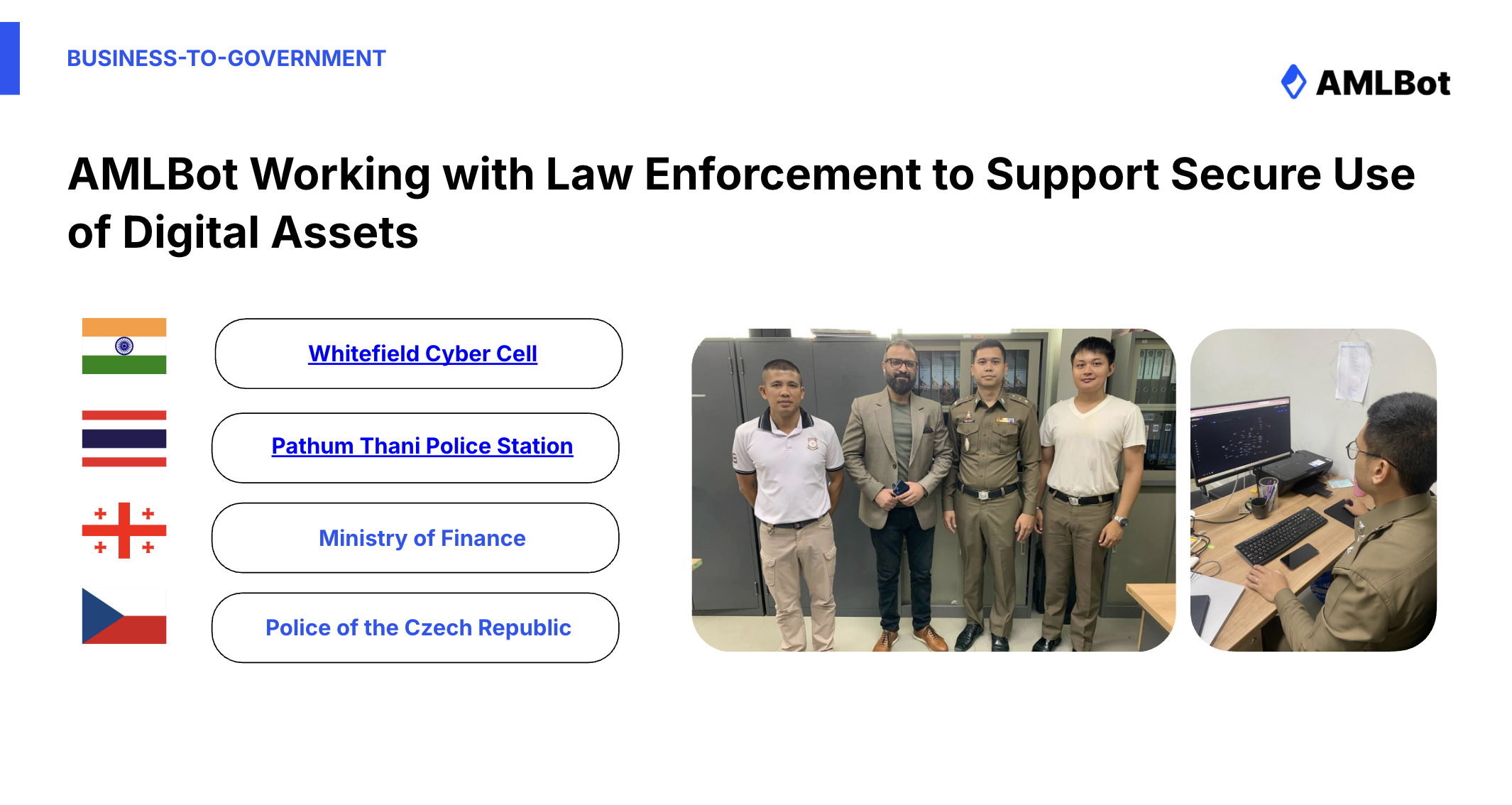
AMLBot works closely with compliance teams, financial institutions, and investigation units worldwide. Beyond this memorandum, AMLBot has supported law enforcement and government agencies in multiple jurisdictions by providing blockchain analytics expertise, advisory input, and professional training within non-commercial frameworks. Recent cooperation has included interactions with cybercrime and financial investigation units in India, Thailand, Georgia, and the Czech Republic, among others.
FATF’s recent guidance is clear. Recovering virtual assets requires more than a legal mandate. It requires the right tools, operational readiness, and investigator training. AMLBot develops solutions that help law-enforcement teams, compliance officers, and fraud units respond to crypto-enabled crime with speed and clarity:
● AMLBot Tracer — Case-Mapping and Fund Flow Visualization
Designed for investigative work, Tracer allows analysts to follow transactions across chains, cluster related entities, and identify risk exposure. This helps teams understand where funds originated, where they moved, and which actors may require escalation.
● Transaction Monitoring (AML) and Alerts — For Ongoing Visibility
For agencies and institutions working with repeated inflows, AMLBot supports ongoing monitoring and configurable alerts, helping detect unusual movement patterns before funds exit traceable networks.
● KYC/KYB Verification — Tools to Verify Identities and Businesses Properly
Our identity-verification tool help businesses confirm who they are dealing with, reduce impersonation and fraud risk, and prevent sanctioned or high-risk actors from entering financial ecosystems.
● Training and Investigative Support — Closing the Capability Gap
We provide structured education programs for investigators and compliance professionals, helping them read blockchain data, recognize risk signals, and apply recovery tactics responsibly. This directly addresses the skills gap highlighted in the FATF Guidance.
“Our goal is simple. Give law-enforcement teams the tools that make it easier to spot suspicious activity, protect people’s assets, and keep their institutions safe when crypto is involved. ” — Vasily Vidmanov, COO, AMLBot
-AMLBot Team
Connect with AMLBot:
🔗 Website
🔗 Telegram AML Bot
🔗 AMLBot Support Team
🔗 AMLBot LinkedIn
🔗 Our Blog
 AMLBot Team
 AMLBot Team
 AMLBot Team