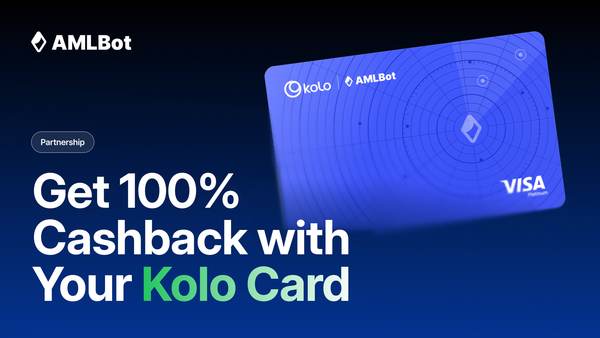

Partnerships AMLBot x Kolo: 100% Cashback on a Kolo Card Payment We're excited to announce our partnership with Kolo. To celebrate, we're launching a joint promo for AMLBot users. Open a Kolo card through AMLBot, meet the promo terms, and get one payment from your first month back in full. Your card will also come in an
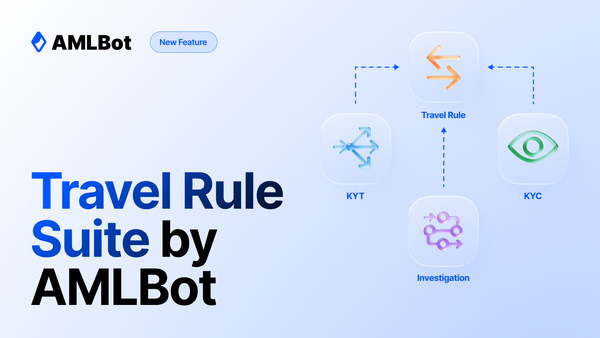
Product Updates Introducing Travel Rule Suite by AMLBot AMLBot has launched Travel Rule Suite, bringing KYC/KYB, KYT, and Travel Rule workflows together with a single login and one support team. In its 2026 survey, the FATF reported that 83% of responding jurisdictions had passed legislation implementing the Travel Rule, up from 73% a year earlier. Your team
AML for Crypto OTC Desks: How to Screen Clients, Wallets, and Trades The hardest compliance moment on an OTC desk is rarely onboarding. It is the message that lands twenty minutes before settlement: a new settlement address, supplied by the client, replacing the one reviewed when the relationship opened. Nothing in that request is necessarily wrong, clients do rotate custodians. But the
Product Updates Featured AMLBot Plans Explained: Personal and Business Checking a wallet before you send funds? Or need full compliance for your company? We've updated AMLBot's plans, so now there are two, and each gives you exactly the depth you need, no more and no less. Personal plan is for simple, affordable AML checks of
Partnerships Bybit on Using AMLBot Tracer as an Independent Verification Layer Bybit, the New Financial Platform trusted by more than 80 million users worldwide, has adopted AMLBot Tracer as an independent verification layer in its investigative workflow — reflecting a growing industry standard: no single blockchain forensics provider is treated as the sole source of truth. With its own attribution data, clustering
Partnerships Why Crypto Wallets Get Flagged and What to Do about It A joint guide by AMLBot × SimpleSwap A swap goes under review when transaction screening surfaces risk indicators in the history of the funds involved, either in the deposit you sent, or in the address the swap is due to pay out to. The review is about the history those funds
What Is the Risk-Based Approach in Crypto AML? Two crypto customers. Both verified. Both onboarded. Customer A is a retail user with predictable transaction patterns, a known funding source, a low-risk jurisdiction, and activity that matches the declared purpose. Customer B is a corporate entity with opaque ownership, a high-risk geography, large unexplained transfers, frequent interactions
AMLBot Academy Synthetic Identity Fraud in Crypto KYC: How AI Helps Fraudsters Bypass Verification On November 13, 2024, FinCEN issued alert FIN-2024-Alert004 after a sustained rise in suspicious activity reports describing deepfake media used against financial institutions. The filings, which FinCEN says began increasing in 2023 and continued through 2024, described criminals altering or creating fraudulent identity documents specifically to get past
AMLBot Academy AML Compliance for RWA Tokenization: KYC, Wallet Screening, and Secondary-Market Transfers "Securities, however represented, remain securities... economic reality trumps labels." That line from SEC Chair Paul Atkins, delivered in a November 2025 speech, became the backbone of the joint staff Statement on Tokenized Securities issued on January 28, 2026 — the most detailed regulatory signal to date that putting an
AMLBot Academy AI Agent Stablecoin Payments: Who Is Responsible for AML Compliance? A software agent finds a paid API. It evaluates the price, determines that the data is needed to complete its task, selects a provider, and initiates a stablecoin payment. The USDT leaves the wallet. The provider confirms receipt and returns the data. The agent continues with its work. The blockchain
AMLBot Academy Web3 Gaming AML Compliance: Player KYC, Wallet Screening, and In-Game Asset Monitoring In a traditional game, value stays inside. A player earns a sword, a skin, or in-game currency — and it remains on the platform, usable only within the game, non-transferable, and ultimately controlled by the developer. In a Web3 game, the same sword may be an NFT on Ethereum,
AMLBot Academy Crypto Donations and Fundraising: How to Screen Incoming Funds for AML Risk An organization publishes a wallet address for donations. Transfers begin arriving from different senders — some who identify themselves, some who do not. A blockchain confirmation shows that each transfer was recorded on-chain. It does not show who controls the sending wallet, where the funds originated, which services they passed
Product Updates Featured AI Tracer: Self-Serve Crypto Investigation, Built for Everyone Blockchain Analytics has always had a steep entry barrier. Reading a transaction path — following funds through intermediate wallets, across chains, knowing which addresses belong to exchanges and which are just pass-through — took either specialist software or hours of manual work in block explorers. For most people who actually need
AMLBot Academy PDF AML Report: When You Need It and What It Can Prove You checked a wallet address or transaction. The screen showed a risk score, exposure categories, and a sanctions status. The result looked fine — or it raised questions. Either way, the moment passed. Now, weeks later, an exchange asks where a deposit came from. A counterparty wants proof that their address
AMLBot Academy AML Software Stack for Growing VASPs: What Compliance Teams Need as Volume Grows A three-person compliance team reviewing 200+ transactions per day can operate with spreadsheets, manual wallet checks, and email-based escalation. The same team reviewing 5,000+ transactions per day cannot — not because the people are less capable, but because the process was never designed to scale. Alerts pile up.
AMLBot Academy USDT TRC-20 AML Check: Why Tron Stablecoin Payments Need Extra Screening In 2024, the TRON blockchain accounted for 58% of all illicit cryptocurrency transaction volume — more than Ethereum, Bitcoin, and all other chains combined. Of that volume, 49% was linked to sanctioned entities and 32% involved blocklisted funds. Separately, on-chain analytics research found that Tron-based USDT dominated high-risk
AMLBot Academy Crypto AML Change Management: How to Keep Compliance Policies and Controls Up to Date In 2024, U.S. federal banking regulators and FinCEN announced more than three dozen enforcement actions against financial institutions for BSA/AML compliance failures. A recurring theme across those cases was not the absence of an AML program. It was the presence of a program that had not been updated
AMLBot Academy Offshore VASP Risk: How Crypto Businesses Should Identify and Manage oVASP Exposure On 11 March 2026, FATF published its report Understanding and Mitigating the Risks of Offshore Virtual Asset Service Providers, making oVASP exposure a named compliance issue rather than a subcategory of general counterparty risk. The report’s central finding is that fewer than half of global jurisdictions—only 46%—have
Crypto Wallet Risk Score Explained: What Low, Medium, and High Risk Actually Mean When you check a crypto wallet before sending or receiving funds, the result comes back as a risk score: Low Risk, Medium Risk, or High Risk. Understanding what that result actually means—and what it does not mean—is the point of this guide. A wallet risk score is a
AMLBot Academy MiCA Transition Period Ends in July 2026: What Happens to Unlicensed Crypto Businesses Many crypto businesses operating in the EU have been relying on transitional arrangements to continue their activities while preparing for or awaiting MiCA authorization. That window is now closing. On 17 April 2026, ESMA confirmed in a formal statement that the MiCA transitional period will officially expire across the EU
AMLBot Academy VARA Licensing in Dubai 2026: AML Requirements for Crypto Businesses in the UAE Crypto businesses planning to operate in or from Dubai need to understand two connected but distinct questions: whether their activities require VARA authorization, and what compliance controls must function after authorization is obtained. These are not the same question, and the second does not disappear once the first is resolved.
AMLBot Academy My Crypto Was Stolen: What Information to Collect Before Asking for Help When crypto is stolen, the first instinct is often to search for someone who can get it back. That is a natural reaction, but before contacting an exchange, investigator, recovery team, law enforcement, or wallet provider, there is a more immediate and useful step: preserving the information you already have.
AMLBot Academy Fake Crypto Recovery Services: How to Avoid Being Scammed Twice When crypto is stolen, the search for help often starts immediately. People type “recover stolen USDT,” “get my crypto back,” or “crypto recovery service” into a search engine, post about the loss on Telegram or Reddit, or describe what happened in a scam report forum. Within hours or days, unsolicited
AMLBot Academy Why Crypto Exchanges Freeze Deposits After AML Checks A crypto deposit can be fully confirmed on the blockchain and still not appear in your exchange balance. Instead of a credited amount, you see a status message: Under Review, Pending Review, or a notification that the deposit is temporarily unavailable. For most users, this is unexpected and stressful—the
AMLBot Academy How to Check a Crypto Wallet for AML Risk Before Sending Funds Before sending crypto to a wallet address, it is worth asking a question that is easy to overlook: what is the transaction history of that address, and does it show any exposure to suspicious sources? A wallet address is just a string of characters. It can look completely ordinary while