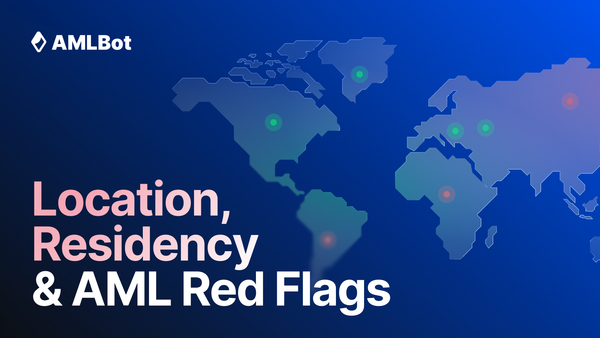

AMLBot Academy Jurisdiction Risk in Crypto AML: How Location, Residency, and Business Geography Affect Compliance Reviews A blockchain transaction contains no country field. There is no line in the data that records where the sender lives, where the receiving business is registered, or which regulator supervises the service on the other end. Everything a compliance team knows about geography, it knows from somewhere else — customer records,
Partnerships Featured Six Layers of Proactive Compliance in Crypto Products: Trustee Plus Case The regulatory question for crypto companies is no longer “Do you have an AML policy?” That bar was cleared years ago. Today’s regulators, banking partners, and supervisory bodies ask something harder: “Can you prove your controls actually work?” Across jurisdictions, VASP requirements are tightening. Travel Rule enforcement is expanding.
AMLBot Academy A Complete Guide: How to Find Your Transaction ID (TxID / Transaction Hash) TL;DR: A TxID is a unique code assigned to every blockchain transaction. You find it in your transaction history on any exchange or wallet, usually by clicking on a specific transaction and looking for "TxID", "Transaction Hash", or "Hash". This guide is here
AMLBot Academy What to Do If Your Crypto Business Received Tainted Funds A crypto business may receive funds that later appear connected to scams, hacks, sanctions, darknet markets, mixers, stolen funds, fraud-related wallets, or other high-risk sources. This does not always mean the business did anything wrong. But it does mean the business now has a problem to manage—and
AMLBot Academy Sanctions Screening for Crypto Businesses: Wallets, Transactions, Customers, and Counterparties On October 15, 2021, the U.S. Department of the Treasury’s Office of Foreign Assets Control published its first industry-specific brochure on sanctions compliance for the virtual currency industry, setting out the components it expects to see in a sanctions program: management commitment, risk assessment, internal controls, testing
AMLBot Academy Launching a Crypto Startup? AML Checklist for Exchanges, Wallets, Payment Apps, and DeFi Products The phrase “crypto startup” tells you almost nothing about which AML obligations apply. A four-person team building a custodial swap interface, a payment processor settling stablecoin invoices for merchants, a token issuer running a redemption desk, and a non-custodial DEX front end all describe themselves the same way
AMLBot Academy Counterparty VASP Due Diligence: A Practical Guide for Crypto Businesses In its June 2025 Targeted Update on Virtual Assets, the Financial Action Task Force (FATF) reported that 85 of 117 responding jurisdictions — about 73% — had passed Travel Rule legislation, up from 65 a year earlier. The number is rising, but it carries a quieter message for anyone moving crypto between
Chainalysis Alternatives: How to Compare Crypto AML Providers for Your Business This guide is written for buyers who are already comparing providers such as Chainalysis, Elliptic, TRM Labs, CipherTrace, AMLBot, and other AML/KYT/blockchain-analytics vendors. The practical takeaway is that there is no single “best” platform for every team. The right fit depends on whether the primary need is
AMLBot Academy How to Choose an AML Platform for EU Crypto Compliance in 2026 On 17 April 2026, the European Securities and Markets Authority confirmed that the MiCA transitional period across the EU will officially expire on 1 July 2026 — after which any entity providing crypto-asset services without a CASP authorization will be in breach of EU law. For the roughly 1,200+
AMLBot Academy FATF Crypto Standards in 2026: Virtual Assets, VASPs, and Recommendation 15 Explained FATF's Seventh Targeted Update, published on 16 July 2026, shows measurable progress in global implementation of Recommendation 15 — but also a shift in where the biggest gaps now sit. As of April 2026, 34% of assessed jurisdictions (51 of 149) are Largely Compliant with R.15, up from
AMLBot Academy Source of Funds in Crypto AML: How to Match Customer Information With On-Chain Evidence Global AML fines jumped roughly 417% in the first half of 2025 compared with the same period in 2024, and crypto exchanges took the single largest share — over $920 million in AML-related penalties across the year, according to industry enforcement-tracking research. Reviewing the 2025 record, regulators kept flagging
AMLBot Academy Crypto AML API Requirements: Data, Alerts, and Compliance Workflow If you run a crypto business in 2026, an AML API is no longer an optional add-on — it is part of the operating fabric. Exchanges, custodial and non-custodial wallets, payment providers, OTC desks, brokers, crypto fintech platforms, and registered VASPs and CASPs all rely on AML APIs to
AMLBot Academy Crypto KYB: How Businesses Verify Corporate Clients and VASPs In its most recent horizontal review of beneficial ownership transparency, the Financial Action Task Force (FATF) reported that the misuse of legal persons — companies, trusts, and similar corporate vehicles — remains one of the most consistently exploited weaknesses in global Anti-Money Laundering systems, with the majority of assessed jurisdictions receiving
Partnerships 🤝 AMLBot Partners with HollaEx® Exchange operators face the same compliance question every day: is the next deposit clean, or is it tied to a mixer, a sanctioned wallet, a scam, a darknet market, or stolen funds? Answering that question manually at scale is not realistic — and getting it wrong is expensive. We're
AMLBot Academy AML Checks for Crypto Trading Platforms: How to Avoid Frozen Client Funds In 2024, an estimated $2.8 billion in crypto assets were frozen by exchanges and regulatory bodies due to compliance issues and illicit activity exposure. Blockchain analytics data shows that flows from illicit sources to centralized exchanges averaged over $14 billion per year between 2020 and 2025, with nearly $7
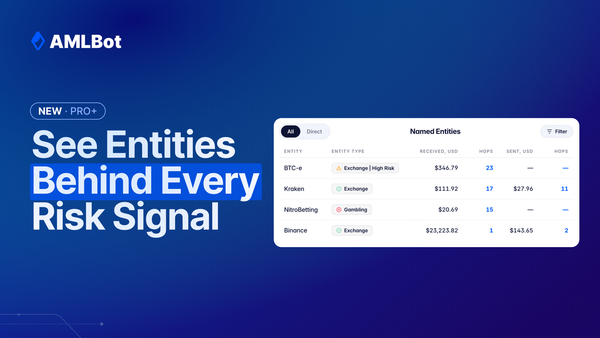
Product Updates Named Entities Connections in AML Check [Update Announcement] A new update to AML Check is rolling out today. It already tells you how risky a wallet or transaction is — this release adds the why, showing the specific entities a wallet or transaction is connected to. What's New AML Check now includes a Named Entities Connections section
AMLBot Academy How to Handle High-Risk Crypto Transaction Alerts: AML Workflow for Businesses Financial institutions filed 4.7 million suspicious activity reports in fiscal year 2024, an average of 12,870 per day. More than 87% of IRS Criminal Investigation cases recommended for prosecution over the prior two years had a related BSA filing. The system works, but only when the process between
AMLBot Academy How Small Crypto Teams Handle AML Checks: Address Screening, Risks, and Tools According to AMLBot's Crypto Crime Report 2025–2026, 65% of crypto incidents investigated across 2,500+ real cases were driven by social engineering — not technical exploits. Investment Scams, Phishing, and Device Compromise accounted for the majority of case volume. The victims were not exclusively large exchanges or institutional
AMLBot Academy KYC vs KYT Explained: Key Differences for Crypto Compliance Independent research conducted across 2024–2025 found that more than 50% of wallets ultimately flagged as high-risk were initially assessed as safe at the time of onboarding. A wallet that passes every identity check on day one can become a conduit for laundered funds on day thirty — and if
AMLBot Academy AML/CFT Risks in Crypto: How Financial Crime Works and How to Detect It Intro According to Crypto Crime Report 2025–2026, 65% of crypto crime cases were driven by Social Engineering rather than Technical Exploits. Investment Scams accounted for 25% of all cases by volume, followed by Phishing (18%) and Device Compromise (13%). The data confirms that modern crypto crime has entered a
AMLBot Academy Illicit Funds Detection in Crypto Transaction Monitoring Crypto Businesses process high volumes of transactions every day, but the real compliance challenge is not volume alone — it is the fact that risk travels through transaction chains, counterparties, and indirect exposure that is rarely obvious at first glance. A wallet may appear clean in isolation while still carrying meaningful
AMLBot Academy Global Crypto Tax Reporting Requirements: Key Jurisdictions Explained A crypto business with entities in New York, London, and Singapore does not have one crypto tax reporting deadline. It has three different first reporting years — 2025, 2026, and 2027 — running under three different frameworks, with filing dates set by three different authorities. Crypto tax reporting no longer follows one
AMLBot Academy Can Stolen Crypto Be Recovered? When Recovery Is Possible — and When It Isn't Can stolen crypto be recovered? Sometimes. The answer depends much more on where the assets end up than on whether the original transaction is visible. A blockchain transaction normally cannot simply be reversed. Yet stolen crypto can sometimes be returned if the funds reach an exchange, a custodian, a controllable
AMLBot Academy Crypto Tax Reporting: What Crypto Businesses Need to Know A crypto platform can hold a fully verified identity file on a customer — passport checked, address confirmed, sanctions screening clean, every AML obligation met — and still be unable to produce a tax report for that customer. The identity is there. The tax residence is not. That gap is the whole
AMLBot Academy OECD Crypto-Asset Reporting Framework (CARF): Requirements for Crypto Businesses On 14 September 2026, Argentina became the 77th jurisdiction to commit to the Crypto-Asset Reporting Framework — with first exchanges due by September 2029, two years after the earliest cohort. That gap is the practical shape of CARF: one international standard, many different start dates. CARF is the OECD standard